
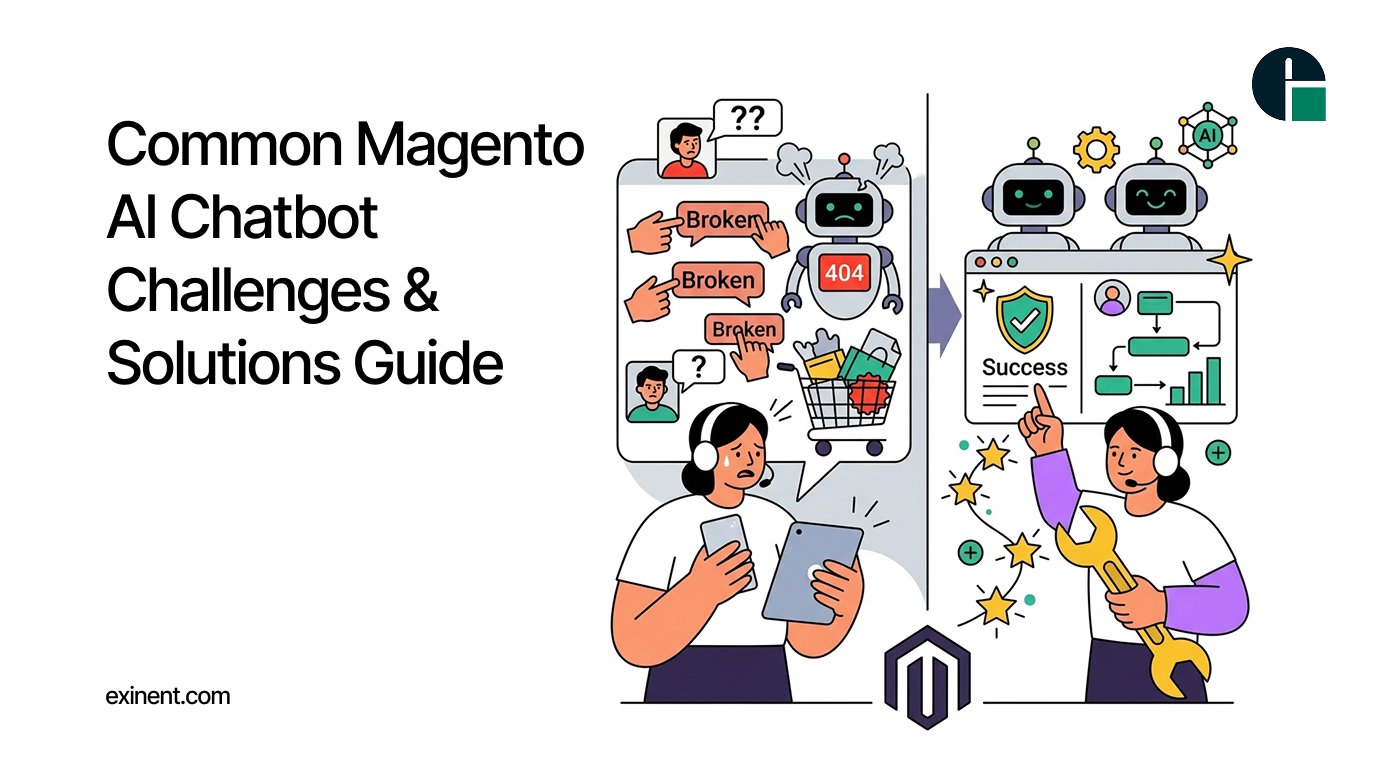
Artificial Intelligence is transforming the way Magento stores engage with customers. From answering product questions and tracking orders to recommending products and reducing support workload, AI chatbots have become an essential tool for modern eCommerce businesses. However, implementing a chatbot isn’t simply about installing an extension and expecting immediate results.
Many Magento store owners encounter challenges during deployment that affect chatbot performance, customer satisfaction, and return on investment. Understanding these obstacles and addressing them early can help businesses maximize the value of AI-powered customer support.
If you’re planning to deploy a Magento AI Chatbot, here are the most common implementation challenges and practical ways to overcome them.
1. Poor Integration with Magento Systems
One of the biggest implementation challenges is integrating the chatbot with Magento’s existing ecosystem. A chatbot that cannot access product catalogs, inventory, customer accounts, or order information provides only limited value.
Without proper integration, customers receive generic responses instead of personalized assistance.
Solution
Choose a chatbot solution that integrates directly with Magento APIs and supports:
- Product catalog synchronization
- Order tracking
- Customer account access
- Inventory updates
- Shopping cart information
A well-integrated chatbot can provide real-time information, making customer interactions faster and more accurate. Experts consistently identify backend integration as one of the primary success factors for AI chatbot deployments.
2. Low-Quality Training Data
Even the most advanced AI chatbot depends on the quality of the information it receives. If your FAQ pages, product descriptions, or support documents contain outdated or inconsistent information, the chatbot may generate inaccurate answers.
This can reduce customer trust and increase support tickets instead of reducing them.
Solution
Create a centralized knowledge base that includes:
- Updated product information
- Shipping policies
- Return procedures
- Warranty details
- Frequently asked questions
Regularly review chatbot conversations to identify incorrect responses and update your knowledge base accordingly. Organizations with structured content and continuous feedback loops tend to achieve better chatbot performance.
3. Unrealistic Expectations
Many businesses expect AI chatbots to solve every customer problem immediately after implementation. In reality, AI performs best when handling repetitive and predictable queries.
Complex issues often require human intervention.
Solution
Start with a limited set of customer service tasks such as:
- Order status
- Product recommendations
- Shipping information
- Return requests
- Store policies
As the chatbot learns from customer interactions, gradually expand its capabilities. A phased rollout is generally more successful than attempting to automate everything at once.
4. Lack of Human Escalation
Customers become frustrated when they cannot reach a human representative after the chatbot fails to resolve their issue.
This is particularly important for:
- Payment issues
- Refund requests
- Technical support
- High-value purchases
Solution
Implement seamless human handoff capabilities.
Your chatbot should detect when it cannot confidently answer a question and immediately transfer the conversation to a live support agent while sharing the conversation history.
This creates a better customer experience and prevents unnecessary frustration.
5. Security and Privacy Concerns
Magento stores handle sensitive customer information, including personal details, payment information, and order history.
Poor chatbot implementation can create security risks if data is not handled properly.
Solution
Ensure your chatbot follows industry security standards by:
- Encrypting customer data
- Using secure API connections
- Following GDPR and other privacy regulations where applicable
- Limiting chatbot access to only necessary information
- Performing regular security audits
Security planning should be built into the implementation process rather than added later.
6. Poor Conversation Design
Some AI chatbots provide robotic, repetitive, or confusing responses that frustrate customers instead of helping them.
A chatbot should feel natural and guide users toward solutions.
Solution
Design conversations that:
- Use simple language
- Offer multiple response options
- Confirm customer intent
- Ask follow-up questions when needed
- Keep responses short and actionable
Testing conversations with real users before deployment can significantly improve the customer experience.
7. Performance and Scalability Issues
As your Magento store grows, chatbot traffic increases during promotions, holiday sales, and product launches.
A chatbot that performs well during testing may struggle during peak traffic periods.
Solution
Deploy scalable infrastructure that supports:
- High concurrent users
- Fast response times
- Cloud-based processing
- Load balancing
- Continuous performance monitoring
Planning for growth from the beginning helps prevent downtime during critical sales events.
8. Failure to Monitor and Improve
Launching a chatbot is only the beginning. Customer behavior changes over time, and your chatbot must adapt accordingly.
Without ongoing monitoring, chatbot performance gradually declines.
Solution
Track key performance indicators such as:
- Resolution rate
- Customer satisfaction (CSAT)
- Average response time
- Escalation rate
- Conversion rate
- Frequently unanswered questions
Review chatbot analytics regularly and retrain the AI using real customer interactions. Continuous optimization is a defining characteristic of successful chatbot deployments.
Best Practices for Successful Magento AI Chatbot Implementation
To maximize ROI, follow these best practices:
- Define clear business goals before implementation.
- Integrate the chatbot with Magento APIs and backend systems.
- Keep product and support information updated.
- Provide smooth escalation to live agents.
- Monitor chatbot performance continuously.
- Train the AI using real customer conversations.
- Prioritize data security and compliance.
- Test thoroughly before launching to customers.
Businesses that treat chatbot implementation as an ongoing optimization process—not a one-time installation—are more likely to improve customer satisfaction, reduce support costs, and increase sales.
Conclusion
Implementing AI chatbots in Magento stores offers significant opportunities to improve customer service, automate repetitive tasks, and drive higher conversions. However, success depends on more than simply enabling AI. Proper integration, high-quality data, security, conversation design, and continuous optimization all play a crucial role.
By understanding these common challenges and addressing them proactively, businesses can create a chatbot experience that truly enhances the customer journey.
Whether you’re launching your first chatbot or upgrading an existing solution, investing in a robust Magento AI Chatbot can help your Magento store deliver faster support, better shopping experiences, and long-term business growth.
FAQ’S :
What are the most common challenges when implementing a Magento AI chatbot?
The most common challenges include poor chatbot training, inaccurate product information, weak Magento integration, slow response times, and limited understanding of customer queries. These issues can reduce customer satisfaction. Regular updates, quality data, and proper testing help solve most implementation problems.
Why does my Magento AI chatbot give incorrect answers to customers?
A Magento AI chatbot usually gives incorrect answers when it is trained on outdated, incomplete, or inconsistent data. Sync your product catalog, FAQs, inventory, and policies regularly. Retraining the chatbot with real customer conversations also improves accuracy over time.
How can I improve the accuracy of a Magento AI chatbot?
Improve chatbot accuracy by using clean product data, updated FAQs, and customer support knowledge bases. Test conversations regularly and review failed interactions every month. AI chatbots typically become more accurate as they learn from verified customer queries and feedback.
What integration problems can happen with a Magento AI chatbot?
Common integration issues include API errors, incompatible extensions, payment gateway conflicts, and inventory synchronization problems. Choose a chatbot that supports Magento’s latest version and offers reliable API documentation. Testing integrations before going live helps prevent unexpected failures.
How do I make a Magento AI chatbot understand customer questions better?
Train the chatbot using real customer conversations, frequently asked questions, and common search terms. Include different ways customers ask the same question, including spelling mistakes and conversational language. Continuous training significantly improves intent recognition and response quality.
Is data security a challenge when using a Magento AI chatbot?
Yes. AI chatbots often process customer names, emails, orders, and payment-related information. Use encrypted connections, role-based access, secure APIs, and comply with regulations such as GDPR or other applicable privacy laws to protect customer data.
How much does it cost to fix Magento AI chatbot implementation issues?
The cost depends on the complexity of the problem. Minor configuration or training updates may require only a few hours, while custom integrations and workflow improvements can take several days or weeks. Planning the implementation carefully reduces long-term maintenance costs.
What are the best practices for successfully implementing a Magento AI chatbot?
Start with clear business goals, integrate the chatbot with Magento correctly, and use high-quality data for training. Test the chatbot with real customer scenarios before launch and monitor its performance continuously. Regular updates and analytics help maintain accuracy and customer satisfaction.
Can a Magento AI chatbot replace human customer support completely?
No. A Magento AI chatbot can automate routine tasks such as answering FAQs, tracking orders, and recommending products, but complex issues still require human agents. A hybrid approach—AI for common questions and humans for advanced support—usually delivers the best customer experience.