
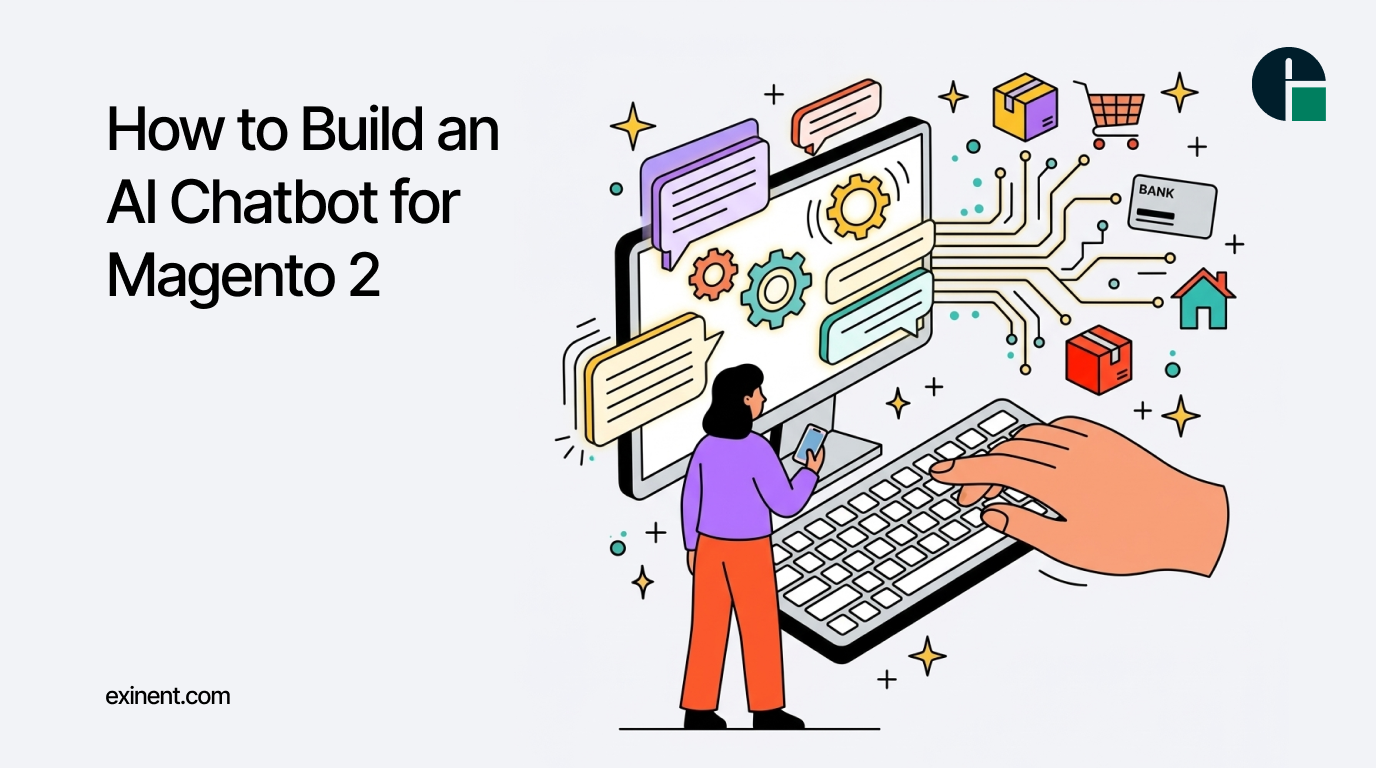
Ecommerce customers expect fast, personalized, and convenient assistance while shopping online. Traditional customer support systems and rule-based chatbots often struggle to understand natural language, product-related questions, and customer intent. This is where an AI chatbot for Magento 2 can make a significant difference.
A Magento AI chatbot can help shoppers discover products, answer questions, track orders, provide recommendations, and resolve common support issues through natural conversations. Modern solutions can also connect with Magento product catalogs, FAQs, store information, and customer workflows to deliver more relevant responses.
If you are planning to implement one, this guide explains how to build an AI chatbot for Magento 2.
What Is an AI Chatbot for Magento 2?
An AI chatbot for Magento 2 is a conversational assistant integrated with a Magento or Adobe Commerce store. Unlike traditional bots that depend primarily on predefined questions and answers, AI-powered chatbots can understand natural language and respond based on the context of a customer’s request.
For example, instead of searching through multiple product categories, a shopper could ask:
“I need a waterproof hiking jacket under $150.”
The chatbot can understand the customer’s requirements and present relevant products. Depending on the implementation, it can also answer questions about product specifications, availability, shipping, returns, and orders.
A well-designed Magento AI Chatbot can therefore function as both a customer-support assistant and a virtual shopping advisor.
Step 1: Define Your Chatbot’s Goals
Before development, determine exactly what you want the chatbot to accomplish.
Common use cases include:
- Product discovery and search
- Product recommendations
- Frequently asked questions
- Shipping and return information
- Order tracking
- Customer support automation
- Cart and checkout assistance
- Cross-selling and upselling
- Human-agent handoff
Start with a focused set of use cases instead of trying to automate every customer interaction immediately. Clear objectives make development, testing, and performance measurement easier.
Step 2: Connect the Chatbot With Magento 2
The chatbot needs access to relevant Magento data to provide useful responses. Depending on your architecture, this can include product names, descriptions, categories, attributes, prices, inventory information, customer FAQs, and order information.
Magento’s APIs and GraphQL can be used to establish communication between the ecommerce platform and the chatbot application. A native integration can allow the chatbot to retrieve current store information rather than relying entirely on static content.
For example, when a customer asks whether a particular product is available, the chatbot should be able to retrieve relevant inventory information instead of giving a generic response.
Step 3: Choose an AI Model
Next, select the AI or large language model that will power the chatbot.
The model should be capable of:
- Understanding natural language
- Maintaining conversational context
- Answering ecommerce-related questions
- Following system instructions
- Generating helpful responses
- Working with external data and tools
Depending on your requirements, you may use a commercial AI API or another suitable language model. Magento chatbot solutions available through the Adobe Commerce Marketplace demonstrate integrations with providers such as OpenAI, Google Gemini, AWS Bedrock, and other AI platforms.
Your choice should consider response quality, API costs, latency, scalability, privacy, and integration requirements.
Step 4: Build a Magento Knowledge Base
An AI model alone does not automatically know your store’s latest products, policies, inventory, or business information.
Create a reliable knowledge base containing information such as:
- Product catalog data
- Product specifications
- Shipping policies
- Return and refund policies
- FAQs
- Store policies
- Category information
- Brand information
- Customer-service documentation
For larger catalogs, retrieval-augmented generation (RAG) can be used. RAG allows the chatbot to retrieve relevant information from your store’s knowledge sources before generating an answer.
This approach can help reduce irrelevant responses and make answers more closely aligned with your actual ecommerce data.
Step 5: Develop the Chatbot Interface
The chatbot should be easy to find without disrupting the shopping experience.
A typical Magento implementation can use a floating chat widget that customers can open whenever they need assistance. The interface should work smoothly across desktop and mobile devices.
Consider adding:
- Suggested questions
- Product cards
- Product images
- Product links
- Add-to-cart actions
- Quick replies
- Order lookup
- Human support options
A conversational interface becomes much more useful when customers can move directly from an AI recommendation to a product page or shopping action.
Step 6: Add Personalization
Personalization can make the chatbot more valuable for ecommerce businesses.
Depending on customer permissions and your privacy requirements, the chatbot can use information such as browsing behavior, purchase history, preferences, or previous conversations to provide more relevant recommendations.
For example, instead of simply showing popular products, it could recommend accessories that complement a customer’s selected product.
Personalized recommendations can support cross-selling, upselling, product discovery, and potentially higher average order values.
Step 7: Add Human Handoff
AI should not necessarily handle every conversation.
Customers may need human assistance for complex refunds, complaints, payment issues, technical problems, or unusual order situations. Your chatbot should recognize when a request exceeds its capabilities and provide a clear path to a human agent.
A strong implementation can transfer the conversation while preserving relevant context, reducing the need for customers to repeat their questions. This human-handoff approach is also supported by modern Magento AI chatbot implementations.
Step 8: Test Security, Accuracy, and Performance
Before launching, thoroughly test the chatbot.
Check whether it:
- Provides accurate product information
- Handles unclear questions correctly
- Avoids inventing product details
- Protects customer information
- Handles API failures gracefully
- Responds quickly
- Works across different devices
- Escalates complex conversations appropriately
Pay special attention to customer and order data. API credentials should be securely stored, and access to private customer information should be limited to authorized workflows.
Step 9: Monitor and Improve the Chatbot
Launching the chatbot is only the beginning. Monitor conversations to identify common questions, incorrect responses, unanswered requests, and opportunities for improvement.
Track metrics such as:
- Chat engagement
- Conversion rate
- Product clicks
- Assisted purchases
- Customer satisfaction
- Support-ticket reduction
- Average response time
- Human handoff rate
Use these insights to continuously improve prompts, knowledge sources, integrations, and conversation flows.
Conclusion
Building an AI chatbot for Magento 2 involves more than adding a chat widget to your ecommerce website. A successful solution requires Magento integration, reliable product and business data, an appropriate AI model, a useful knowledge base, personalization, security, and ongoing optimization.
When implemented correctly, an AI chatbot can provide 24/7 shopping assistance, automate repetitive customer-support requests, improve product discovery, and create a more convenient customer experience. Modern Magento AI chatbot solutions can integrate with product catalogs, order workflows, FAQs, and multiple storefront environments to support scalable ecommerce operations.
If you want to create a smarter shopping experience for your Magento store, explore Magento AI Chatbot and discover how AI-powered conversational commerce can transform customer engagement and support.