
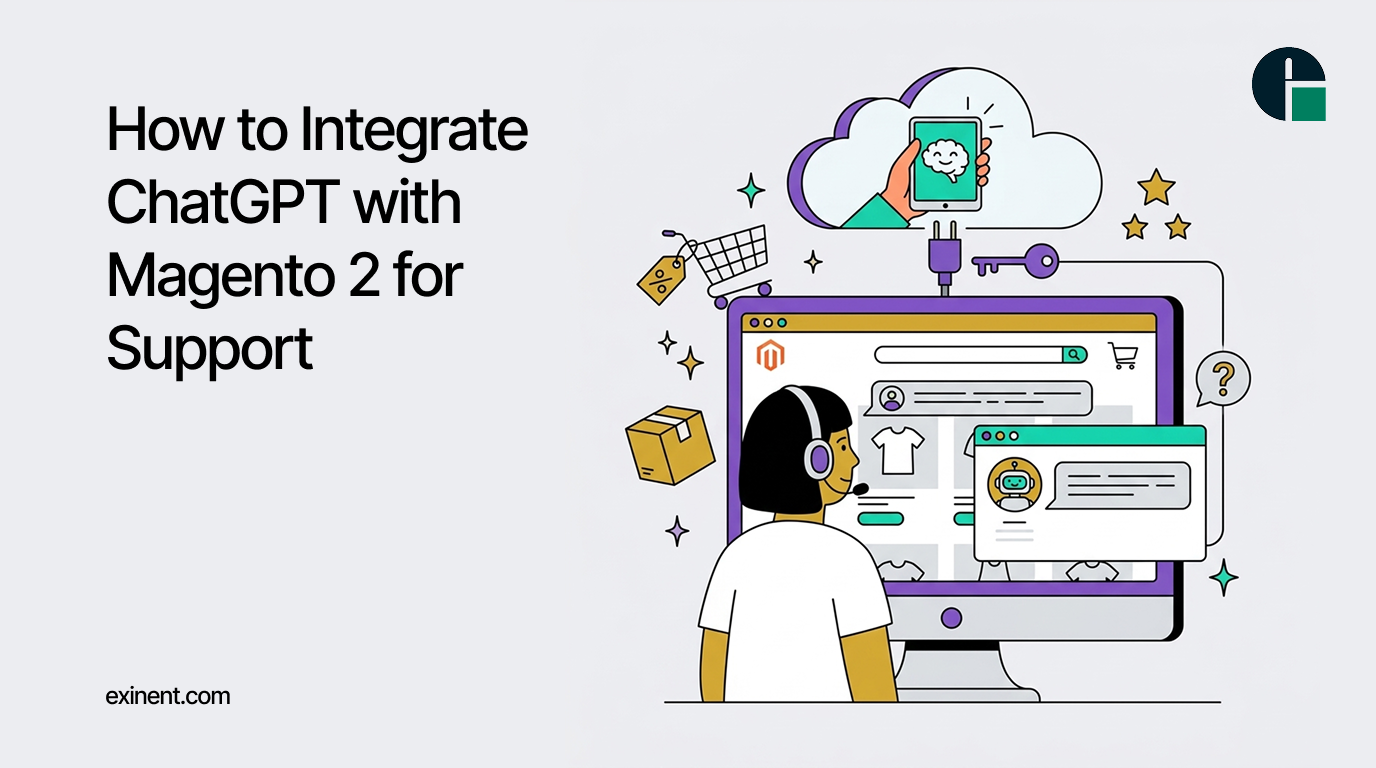
Customer expectations for online shopping are changing rapidly. Shoppers want quick answers about products, orders, shipping, returns, payments, and store policies—often outside traditional business hours. For Magento 2 merchants, integrating ChatGPT into the storefront can provide an intelligent, always-available customer support experience while reducing the workload on support teams.
A well-designed Magento AI Chatbot can understand customer questions, provide relevant responses, guide shoppers toward products, and connect users with human agents when more complex assistance is required. Magento 2’s REST and GraphQL APIs make it possible to connect external applications and services with store functionality.
What Is ChatGPT Integration with Magento 2?
ChatGPT integration connects an AI-powered conversational interface with your Magento 2 store. Instead of simply displaying predefined FAQs, the chatbot can understand natural-language questions and generate useful responses based on your store’s information and business rules.
For example, a customer could ask:
- “Where is my order?”
- “Do you have this shirt in medium?”
- “What is your return policy?”
- “Which laptop is best for students?”
- “Can I change my shipping address?”
- “Are there any discounts available?”
The chatbot can use information from your Magento catalog, customer service knowledge base, and selected store APIs to provide relevant assistance.
Benefits of Integrating ChatGPT with Magento 2
1. 24/7 Customer Support
Unlike traditional support teams, an AI chatbot can respond to customers around the clock. This is particularly useful for international Magento stores serving customers across multiple time zones.
2. Faster Responses
Customers do not have to wait for an email response or a support representative. ChatGPT can immediately answer common questions, helping reduce response times and improving the overall shopping experience.
3. Product Discovery
AI can help shoppers find products based on their requirements. Instead of searching through multiple categories, customers can describe what they need conversationally.
For example, a customer could say, “I need running shoes under $100 for beginners.” The chatbot can use available product information to guide the shopper toward suitable products.
4. Reduced Support Workload
Many ecommerce support requests are repetitive. Questions about delivery times, return policies, order status, and product availability can often be handled automatically, allowing human agents to focus on more complicated cases.
Steps to Integrate ChatGPT with Magento 2
Step 1: Define Your Customer Support Use Cases
Before developing the integration, identify the tasks you want the chatbot to handle.
Start with common support scenarios such as:
- Product questions
- Order status
- Shipping information
- Returns and refunds
- Frequently asked questions
- Store policies
- Product recommendations
Clearly defining these use cases will help determine which Magento APIs and data sources the chatbot needs.
Step 2: Set Up Your ChatGPT/API Layer
Create a secure backend service that communicates with the AI model. The backend should receive a customer’s message, prepare the relevant store information, send an appropriate request to the AI service, and return the response to the Magento storefront.
Avoid placing sensitive API credentials directly in JavaScript running in the customer’s browser. API keys should remain securely stored on the server.
Your backend can also apply business rules before sending information to the AI model. For example, it can restrict the types of customer or order data that may be included in a conversation.
Step 3: Connect Magento 2 APIs
Magento 2 provides REST and GraphQL APIs for connecting external applications with commerce functionality. Magento’s web API framework supports integrations with third-party applications and provides authentication and access controls.
For example, your chatbot backend may need access to selected product, inventory, customer, or order information.
Magento integrations can be configured through System > Extensions > Integrations, where merchants can define the resources available to a third-party integration.
Only grant the permissions the chatbot actually needs. Limiting API access is an important security practice.
Step 4: Build the Chatbot Interface
The next step is to add a conversational interface to the Magento storefront.
This can be implemented as a chat widget that appears in the bottom corner of the website. Customers can open it, type questions, and receive AI-generated responses without leaving the current page.
The interface should be mobile-friendly and provide clear options for contacting a human support representative when necessary.
Step 5: Provide Relevant Store Knowledge
ChatGPT should not be expected to know your store’s private policies automatically. Give the chatbot access to reliable information such as:
- Product descriptions
- Shipping policies
- Return and refund policies
- FAQs
- Payment information
- Warranty details
- Store contact information
For better accuracy, use a controlled knowledge source or retrieval layer so that the chatbot can reference current store information before generating an answer.
Step 6: Add Human-Agent Escalation
AI should complement your support team rather than replace it completely.
Create an escalation workflow for situations involving complaints, complicated refunds, payment problems, account issues, or questions the chatbot cannot confidently answer.
The chatbot can collect basic information and transfer the conversation to a human agent, reducing the amount of repetitive information customers need to provide.
Step 7: Test and Monitor the Integration
Before launching the chatbot, test it against realistic customer questions.
Check whether it:
- Provides accurate product information
- Follows store policies
- Handles unknown questions appropriately
- Protects customer information
- Escalates complicated requests
- Works correctly on mobile devices
- Maintains acceptable response times
Continue monitoring conversations after launch. Reviewing failed or misunderstood queries can help improve prompts, knowledge sources, and business rules.
Security Considerations
Security should be a priority when connecting AI with Magento 2. Do not expose API credentials or unnecessarily send sensitive customer information to an AI service.
Use HTTPS, restrict Magento API permissions, validate requests, and carefully control access to customer and order information. Magento’s API authentication mechanisms are designed to control access to protected resources, and integration permissions should be limited according to business requirements.
It is also important to prevent the chatbot from performing sensitive actions without appropriate authorization and validation.
Why Magento AI Chatbots Are Valuable for Ecommerce
A properly implemented Magento AI Chatbot can become more than a simple FAQ tool. By connecting conversational AI with Magento’s product and customer-service ecosystem, businesses can create a more personalized shopping experience while automating repetitive support tasks.
For ecommerce businesses looking to modernize customer service, Magento AI Chatbot solutions can help combine conversational AI with Magento’s ecommerce capabilities.
Conclusion
Integrating ChatGPT with Magento 2 can transform customer support by providing faster answers, 24/7 assistance, product discovery, and automated responses to repetitive questions. The key to a successful implementation is not simply adding a chat window—it is creating a secure architecture that combines AI with accurate store information, controlled Magento API access, and human-agent escalation.
With careful planning, testing, and continuous optimization, Magento merchants can use AI-powered customer support to improve customer satisfaction while making support operations more efficient.