
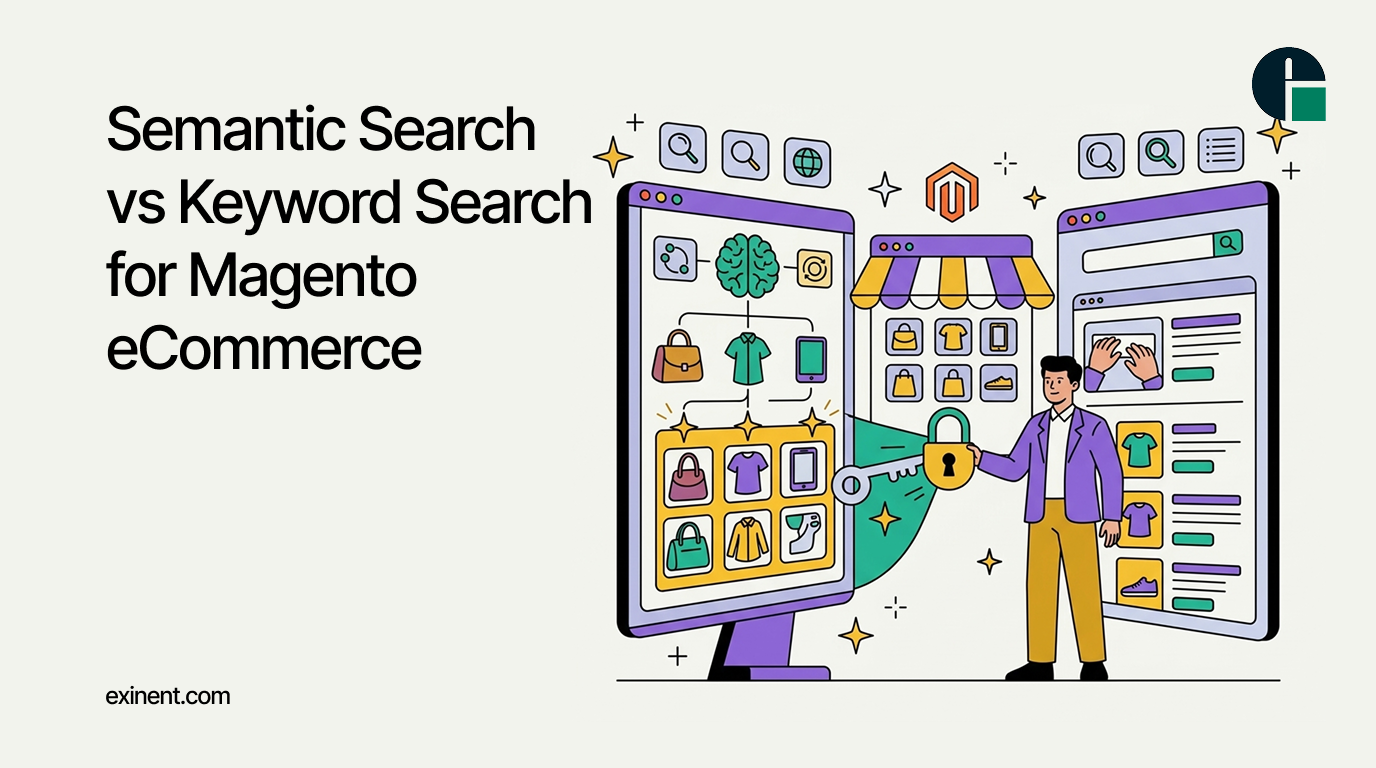
Search is one of the most important parts of an eCommerce website. When shoppers cannot quickly find the products they want, they are more likely to leave the store and look elsewhere. For Magento eCommerce businesses, choosing the right search technology can directly influence product discovery, customer experience, and conversions.
Traditional keyword search has been the standard approach for years. However, as shoppers increasingly use conversational and descriptive queries, semantic search is becoming a more powerful alternative. So, what is the difference between semantic search and keyword search, and which one is better for a Magento store?
What Is Keyword Search?
Keyword search works by matching the words entered by a shopper with keywords stored in product names, descriptions, SKUs, categories, and attributes.
For example, suppose a customer searches for:
“black running shoes”
A keyword-based Magento search engine looks for products containing terms such as “black,” “running,” and “shoes.” Products that closely match those words are returned in the search results.
Keyword search is straightforward and can work well when customers know the exact product terminology used by the store. It is also useful for searches involving specific SKUs, product names, model numbers, or technical terms.
However, keyword search can struggle when shoppers use natural language, synonyms, typos, or terms that are different from the wording in the product catalog.
What Is Semantic Search?
Semantic search focuses on understanding the meaning and intent behind a search query, rather than simply matching individual words.
For example, a shopper might search:
“comfortable shoes for walking all day”
A traditional keyword search may look for products containing words such as “comfortable,” “walking,” and “shoes.” A semantic search system can interpret the intent behind the query and identify products associated with comfort, walking, cushioning, and everyday use—even when the exact words are not present in the product title.
AI-powered semantic search can use Natural Language Processing (NLP), machine learning, vector representations, and contextual understanding to identify relationships between search queries and products.
For Magento stores, this creates a more natural shopping experience because customers can search using the same language they would use when speaking to a salesperson.
Semantic Search vs Keyword Search: Key Differences
The biggest difference is how each technology interprets a shopper’s query.
| Feature | Keyword Search | Semantic Search |
|---|---|---|
| Matching | Matches words | Understands meaning and intent |
| Natural-language queries | Limited | Strong |
| Synonyms | Requires configuration | Can understand related concepts |
| Typos | Basic correction may be available | Can interpret intent despite errors |
| Long-tail searches | Can produce poor results | Better suited |
| Context | Limited | Context-aware |
| Conversational queries | Limited | Strong |
| Product discovery | Based on exact terms | Based on relevance and intent |
| AI capabilities | Usually limited | Core component |
Keyword search is primarily concerned with what the customer typed. Semantic search focuses more on what the customer means.
Why Keyword Search Can Become a Problem for Magento Stores
Magento catalogs can contain thousands or even millions of products with complex attributes, categories, configurable options, and variations. As the catalog grows, relying exclusively on exact keyword matching can create search challenges.
Consider a customer searching for:
“warm casual jacket for an October evening.”
The customer may be looking for fall outerwear, but the exact phrase may not exist anywhere in the product catalog. A traditional search engine may return limited results or no results.
Similarly, shoppers may type:
- “laptop for college students”
- “waterproof shoes for hiking”
- “office dress for summer”
- “small sofa for apartment”
- “gift for a coffee lover”
These queries express shopping intent, not simply product names.
This is where semantic search can provide a significant advantage.
How Semantic Search Improves Magento Product Discovery
An AI-powered search solution can analyze the context of a query and connect it with relevant product attributes.
For example:
Query: “waterproof running shoes under $100”
Instead of treating this as four unrelated keywords, semantic search can interpret the request as a combination of:
- Product category: Running shoes
- Attribute: Waterproof
- Price condition: Under $100
The search engine can then return products that satisfy the overall intent.
Modern AI search solutions for Magento can also support natural-language processing, typo handling, personalized ranking, visual search, and intelligent product recommendations. Exinent’s Magento AI Product Search is designed to understand conversational queries and product intent instead of relying solely on literal keyword matching.
Which Search Approach Is Better for Magento?
The answer depends on the requirements of your store.
Keyword search remains useful for specific searches such as:
- Product SKUs
- Exact product names
- Model numbers
- Brand names
- Technical specifications
However, semantic search becomes particularly valuable when your customers frequently use descriptive, conversational, or long-tail queries.
For many Magento stores, the best solution is not necessarily to completely eliminate keyword search. Instead, businesses can combine keyword matching with semantic understanding.
This hybrid approach can provide the precision of keyword search while adding the flexibility of AI-powered intent recognition.
Benefits of AI-Powered Semantic Search for eCommerce
Implementing intelligent search can improve several areas of the Magento shopping experience.
1. Faster Product Discovery
Customers can describe what they need naturally instead of learning how your catalog is organized.
2. Fewer Zero-Result Searches
Semantic understanding can identify relevant products even when the customer’s exact words do not appear in the catalog.
3. Better Customer Experience
A search experience that understands intent feels more intuitive and conversational.
4. Higher Search Conversions
When shoppers find relevant products faster, they have a clearer path toward purchasing.
5. Better Cross-Selling and Upselling
AI-powered search can also use product relevance and shopping behavior to surface complementary or higher-value products.
6. Useful Search Analytics
Modern AI search platforms can provide insights into popular queries, zero-result searches, search conversion rates, customer intent, and other search behavior.
Final Thoughts
The difference between keyword search and semantic search comes down to matching words versus understanding intent.
Keyword search remains valuable for precise product and SKU searches, but modern shoppers increasingly expect eCommerce websites to understand conversational queries. Semantic search helps Magento stores bridge that gap by interpreting the meaning behind searches and connecting customers with relevant products.
For stores with large catalogs, diverse product attributes, or customers who frequently use natural-language searches, investing in Magento AI Product Search can be an effective way to improve product discovery and create a more intelligent shopping experience.
As eCommerce becomes increasingly AI-driven, search is no longer just a navigation feature. It is becoming an important part of the customer journey—and potentially one of the most valuable sales tools on a Magento store.
FAQ’S :
What is semantic search vs keyword search for Magento eCommerce?
Keyword search matches products based mainly on the exact words or phrases shoppers enter. Semantic search uses AI to understand the meaning and intent behind a query, so it can return relevant products even when the search terms do not exactly match product data.
How does semantic search work in Magento eCommerce?
Semantic search analyzes the meaning, context, and relationships between search terms rather than relying only on exact keyword matches. For example, a search for “comfortable office shoes” can identify products described as “cushioned formal footwear,” even if the exact phrase is not present.
What are the benefits of semantic search for Magento stores?
Semantic search can improve product relevance, handle natural-language queries, and help shoppers discover products faster. It can also reduce zero-result searches and improve product discovery by understanding synonyms, related terms, and search intent.
Is semantic search better than keyword search for Magento 2?
Semantic search can be more effective for complex, conversational, or intent-based queries, while keyword search works well for specific product names, SKUs, and exact terms. Many Magento stores can benefit from combining both approaches instead of replacing keyword search completely.
What is the difference between semantic search and keyword search in Magento?
Keyword search focuses on matching query words with indexed product information, while semantic search focuses on understanding the query’s meaning. For example, “winter footwear for hiking” may produce broader, contextually relevant results with semantic search than with exact keyword matching.
Can semantic search handle misspelled searches in Magento?
Yes, AI-powered semantic search can help interpret misspelled or incomplete product searches when combined with typo-tolerance and natural-language processing. For example, a query such as “runing shose” can potentially be mapped to relevant running shoe products.
Does semantic search improve Magento product discovery and conversions?
Semantic search can improve product discovery by showing more relevant results for broad or conversational queries. Better search relevance can reduce search frustration and help shoppers find suitable products, which may contribute to higher engagement and conversions.
How can I implement semantic search in a Magento 2 store?
A typical implementation involves 1) selecting an AI or semantic search solution, 2) connecting it with the Magento product catalog, 3) indexing product data, and 4) testing search relevance with real customer queries. Store owners should also monitor zero-result searches and refine search settings over time.
What are the risks of using semantic search for Magento eCommerce?
Semantic search may return overly broad or less precise results if product data, attributes, or relevance settings are poorly configured. It can also require additional infrastructure, integration work, and ongoing testing compared with a basic keyword-based search system.
Is AI semantic search worth it for a Magento eCommerce store?
Semantic search can be worthwhile for stores with large catalogs, complex product attributes, or customers who frequently use natural-language queries. Before implementation, compare search accuracy, integration costs, performance, and conversion metrics against your existing Magento search experience.