
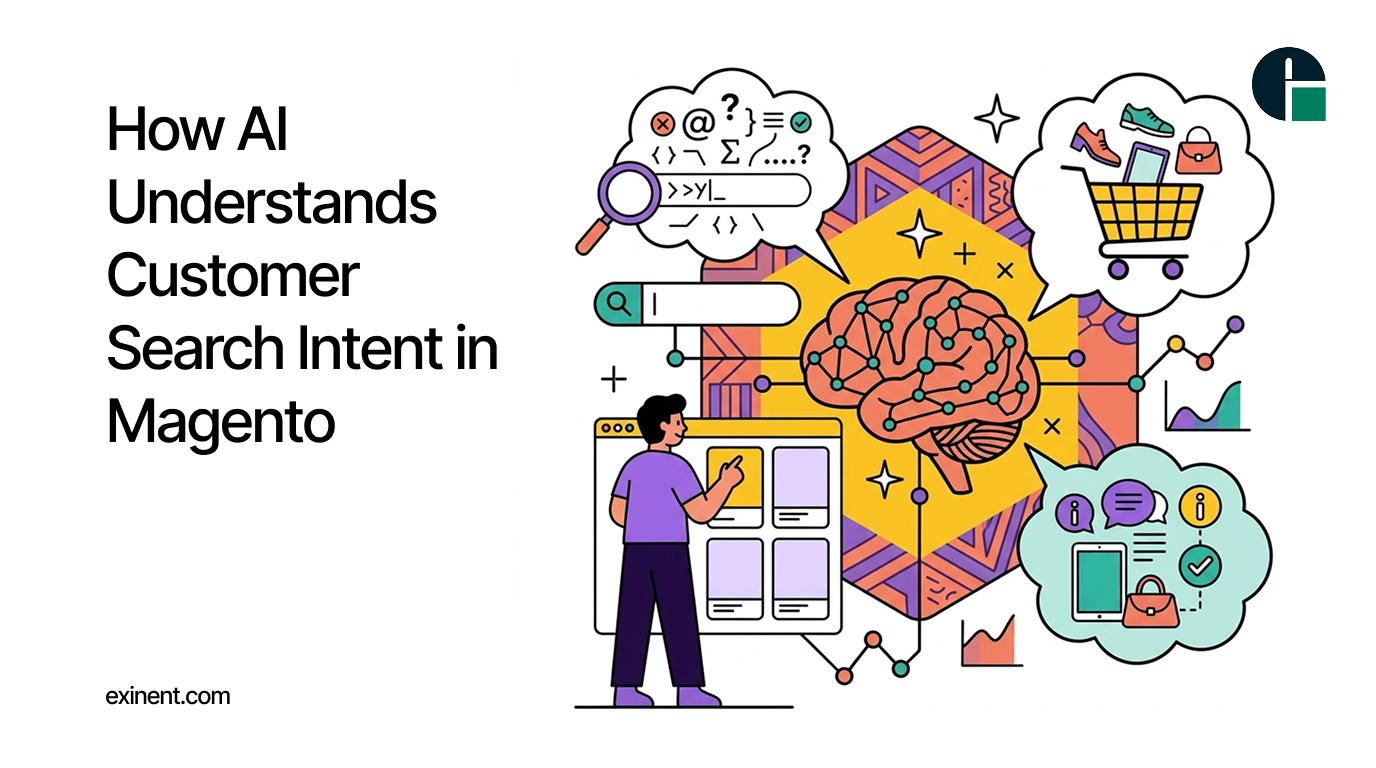
E-commerce search has evolved far beyond matching the words a customer types into a search box. Modern shoppers often use natural language, describe a need instead of a product, make spelling mistakes, or combine several requirements in a single query.
For example, a customer may search for “comfortable shoes for walking all day under $100” instead of simply typing “walking shoes.” A traditional keyword-based search may struggle to understand the complete request. AI-powered search, however, can interpret the meaning behind the query and connect it with relevant products.
For Magento AI Product Search and Adobe Commerce stores, understanding customer search intent can significantly improve product discovery and create a smoother path from search to purchase. Adobe describes semantic search as an AI-based approach that understands what shoppers mean rather than relying only on the exact words they enter.
What Is Customer Search Intent?
Search intent refers to what a customer actually wants to accomplish when they perform a search.
Consider these examples:
- “Black running shoes” — the customer wants a specific product category and color.
- “Shoes for standing at work” — the customer is describing a need.
- “Best laptop for graphic design” — the customer is researching before purchasing.
- “Waterproof jacket under $150” — the customer has product, feature, and price requirements.
- “Nike sneakers size 10” — the customer has a specific brand and product preference.
Traditional search primarily looks for matching words. AI search attempts to understand the relationship between the words, context, product attributes, and likely shopping objective.
Adobe Commerce’s current semantic search capabilities similarly combine semantic understanding with traditional keyword matching to improve relevance when shoppers use descriptive or natural-language queries.
How AI Understands Search Intent
1. Natural Language Processing
The first step is understanding the language used in the search query.
AI uses Natural Language Processing (NLP) to break a query into meaningful concepts.
For example:
“Lightweight waterproof hiking jacket under $150”
AI can identify:
- Product type: jacket
- Use case: hiking
- Feature: waterproof
- Preference: lightweight
- Budget: under $150
Instead of treating the entire query as one string, the search engine can interpret these individual signals and use them to find suitable products.
2. Understanding Context and Meaning
Customers don’t always use the same words that merchants use in product catalogs.
A shopper might search for:
“comfortable couch for a small apartment.”
The catalog could contain a product named:
“Compact 3-Seater Fabric Sofa.”
A keyword-only engine may not recognize the relationship between “couch” and “sofa” or understand that “small apartment” indicates a preference for compact furniture.
AI-powered semantic search can connect related concepts based on meaning. Adobe gives similar examples where searches such as “leather couch” can surface products described as “leather sofa.”
3. Recognizing Product Attributes
Magento catalogs contain structured product information such as:
- Brand
- Color
- Size
- Material
- Price
- Category
- Compatibility
- Weight
- Features
- Availability
AI can interpret these attributes alongside the customer’s query.
For example:
“Gaming laptop with 32GB RAM under $2,000.”
The search engine can understand that the customer is looking for:
Gaming laptop + 32GB RAM + maximum $2,000
It can then prioritize products satisfying the strongest requirements instead of simply displaying products containing the words “gaming” and “laptop.”
4. Handling Typos and Different Terminology
Customers frequently make spelling mistakes or use alternative terminology.
Someone might type:
“runing shose”
instead of:
“running shoes.”
A sophisticated AI search system can identify the intended meaning and return appropriate products.
Similarly, shoppers may use terms such as:
- Sneakers instead of athletic shoes
- Sofa instead of couch
- Mobile instead of smartphone
- TV instead of television
- Backpack instead of rucksack
AI helps bridge the vocabulary gap between customers and product catalogs.
5. Understanding Long-Tail Queries
Long-tail searches often contain valuable purchase information.
For example:
“Women’s black waterproof boots for winter under $120.”
A basic search engine may struggle because the exact phrase may not appear anywhere in the catalog.
AI can extract the important concepts:
Audience: Women
Color: Black
Feature: Waterproof
Season: Winter
Product: Boots
Budget: $120
This produces a much more useful search experience.
6. Using Behavioral Signals
Search intent isn’t always determined by the query alone.
AI-powered search can also use behavioral signals such as:
- Previous searches
- Product clicks
- Browsing behavior
- Purchase history
- Frequently viewed categories
- Search refinements
- Add-to-cart activity
For example, if a returning customer frequently searches for professional photography equipment, AI can potentially use that context to make future product discovery more relevant.
Exinent’s Magento AI search approach also focuses on search behavior and analytics, including customer intent, popular searches, zero-result searches, click-through rates, and search-generated revenue.
AI Search vs. Traditional Magento Search
Traditional keyword search generally follows a straightforward process:
Customer Query → Keyword Matching → Product Results
AI-powered search adds an intent layer:
Customer Query → NLP → Intent Detection → Semantic Understanding → Attribute Matching → Ranking → Product Results
This difference becomes especially important when customers use conversational language.
For example:
Traditional search:
“comfortable shoes for standing all day”
AI search:
Understands that the customer is looking for footwear optimized for prolonged standing, comfort, and likely support.
The goal isn’t necessarily to replace keyword search. Modern Magento search experiences can combine keyword matching with semantic understanding to improve overall relevance.
Why Search Intent Matters for Magento Stores
Search is one of the strongest indicators of customer interest. When visitors actively search for products, they are often further along in their buying journey.
Poor search experiences can create:
- Zero-result pages
- Irrelevant products
- Search abandonment
- Lower conversion rates
- Longer product discovery times
- Lost sales
AI can help turn the search bar into a more intelligent product discovery tool.
Businesses looking to implement this approach can explore Magento AI Product Search, which uses semantic intent, natural-language understanding, and catalog data to improve product discovery.
Turning Search Intent Into Better Conversions
Understanding intent is only useful when the Magento store can act on it.
Once AI identifies what a shopper wants, the system can:
- Rank relevant products higher
- Apply appropriate filters
- Suggest alternative products
- Recommend complementary products
- Handle synonyms and typos
- Reduce zero-result searches
- Personalize product discovery
- Promote relevant inventory
For example, if a shopper searches for “waterproof running shoes under $100,” the ideal search experience should immediately prioritize products that match waterproof functionality, running use, and the customer’s price range.
Exinent’s AI search solution is designed around this type of intent-based product discovery and supports natural-language queries, visual search, automated ranking, and search analytics.
The Future of Magento Search Is Intent-Based
Customers don’t think like databases. They don’t always know Magento attribute names, product SKUs, or the exact terminology used in a catalog. They simply describe what they need.
AI helps Magento stores translate those natural customer requests into meaningful product matches.
As e-commerce becomes increasingly conversational, search intent will become more important than exact keyword matching. AI-powered semantic search gives Magento merchants an opportunity to make product discovery faster, more intuitive, and more relevant.
Ultimately, the goal is simple: understand what the customer means, not just what the customer types. When Magento search can make that distinction, every search becomes a stronger opportunity to connect shoppers with the right products and move them closer to purchase.
FAQ’S :
What is AI-powered search intent in Magento?
AI-powered search intent in Magento is the process of understanding what a customer means rather than matching only the exact words they type. It uses technologies such as natural language processing and machine learning to identify whether a shopper is looking for a specific product, feature, category, or solution.
How does AI understand customer search intent in Magento?
AI analyzes search terms, context, product attributes, customer behavior, and related language to determine intent. For example, a search for “comfortable shoes for running” can be interpreted as a request for running shoes with comfort-related features, even when those exact words are not product names.
What are the benefits of AI search intent analysis for Magento stores?
AI search intent analysis can improve product relevance, reduce zero-result searches, and help customers find products faster. It can also support higher engagement and conversions by displaying products that better match the shopper’s actual needs.
Can Magento AI search understand long-tail and natural language queries?
Yes. AI-powered Magento search can interpret longer, conversational queries such as “black waterproof jackets for winter travel.” Instead of relying only on keyword matches, it can analyze the meaning and attributes within the query to return more relevant products.
How does AI handle ambiguous customer searches in Magento?
AI can use query context, product data, previous interactions, and behavioral signals to determine the most likely meaning of an ambiguous search. For example, “apple” could refer to a product category, brand, or other item depending on the store’s catalog and customer context.
Can AI understand misspelled product searches in Magento?
Yes. AI search can use techniques such as typo correction, fuzzy matching, and semantic understanding to interpret misspelled queries. A search like “nik shoes” may still return relevant Nike products instead of showing a zero-results page.
How does AI search intent improve product discovery in Magento?
AI connects customer intent with product attributes, categories, and descriptions to provide more relevant search results. This helps shoppers discover suitable products even when their search terms do not exactly match the product catalog.
What are the risks of using AI to understand search intent in Magento?
Incorrect product data, poorly configured AI models, or insufficient search training can lead to irrelevant results. Stores should monitor search analytics, zero-result queries, click-through rates, and customer behavior to identify and correct these issues.
How can Magento stores improve AI search intent accuracy?
Start with accurate product attributes, descriptions, categories, and synonyms. Then analyze search queries regularly, review unsuccessful searches, configure relevant ranking rules, and continuously evaluate AI results using customer behavior and conversion data.
Is AI-powered search intent worth it for Magento eCommerce stores?
AI-powered search can be valuable for Magento stores with large catalogs, complex product attributes, or frequent natural-language searches. It is particularly useful when traditional keyword search produces irrelevant results, missed products, or many zero-result queries.