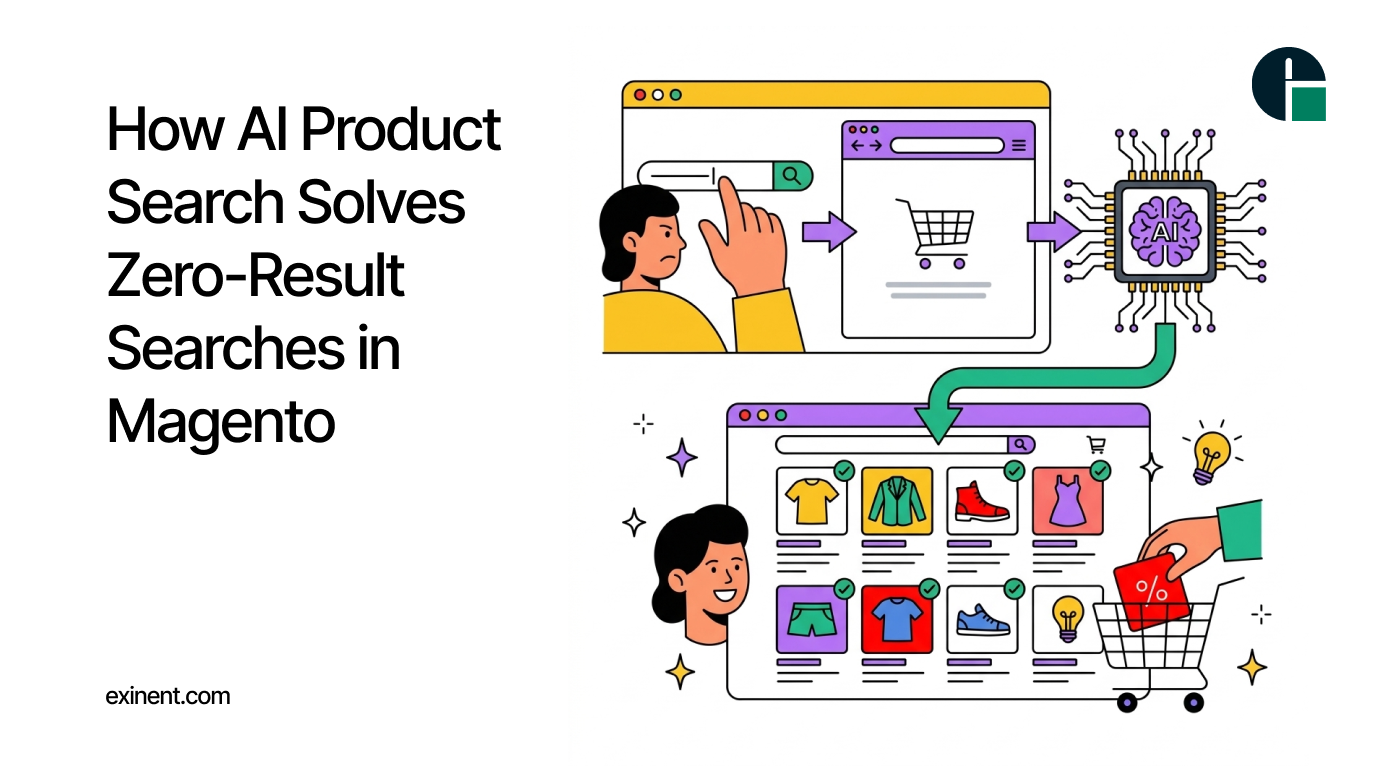
For an eCommerce store, few things are more frustrating than a customer searching for a product and seeing a “No Results Found” page. The shopper may know exactly what they want, but if Magento search cannot understand their query, the buying journey can end immediately.
Traditional keyword-based search often depends on matching the words entered by shoppers with words stored in product names, descriptions, attributes, and categories. However, customers do not always search using the same terminology used by merchants. They may use synonyms, natural language, abbreviations, typos, or descriptive phrases.
This is where AI-powered product search can make a significant difference. By understanding search intent and meaning rather than relying only on exact keyword matches, AI search can connect shoppers with relevant products even when their queries do not perfectly match catalog content. Adobe Commerce also describes semantic search as a way to reduce zero-result searches by understanding what shoppers mean rather than simply matching the exact words they type.
What Causes Zero-Result Searches in Magento?
A zero-result search occurs when a shopper enters a query but the search engine cannot identify a matching product.
There are several common reasons for this:
- The shopper uses a synonym that is not present in the catalog.
- The query contains spelling mistakes.
- The shopper uses conversational language.
- Product information uses different terminology.
- The customer enters a long-tail or highly descriptive query.
- Product attributes are not properly configured for search.
- The shopper searches for a product based on its intended use rather than its name.
For example, a customer might search for “comfortable shoes for standing all day.” A product catalog may instead describe those products as “cushioned work shoes” or “supportive sneakers.” A conventional keyword search may struggle to connect these phrases, while semantic search can understand the relationship between the query and product information.
How AI Product Search Prevents Zero Results
1. It Understands Search Intent
The biggest advantage of AI search is its ability to understand what the customer actually wants.
Instead of treating a query as a collection of independent keywords, AI-powered search analyzes the meaning and context behind the query. For example, a search such as “waterproof jacket for winter hiking” can be interpreted as a combination of product category, weather protection, season, and intended activity.
This allows the search engine to identify relevant products even when the exact phrase does not appear in the product title.
For Magento merchants, this means shoppers can search naturally instead of learning the exact terminology used in the store catalog.
2. It Handles Synonyms and Different Terminology
Customers frequently use different words to describe the same product.
Someone may search for:
- “sofa” instead of “couch”
- “sneakers” instead of “trainers”
- “phone case” instead of “mobile cover”
- “hoodie” instead of “sweatshirt”
AI semantic search can identify relationships between these terms and improve product matching. Adobe Commerce notes that semantic search can reduce the need for manually maintaining synonyms for common word variations.
This is particularly valuable for large Magento catalogs where maintaining thousands of manual synonym rules can become difficult.
3. It Understands Misspelled Searches
Shoppers do not always type perfectly, especially when using mobile devices.
A customer might search for “runing shos” instead of “running shoes.” If the search engine only looks for an exact text match, the result may be empty.
AI-powered search can use language processing to recognize likely intent and return relevant products despite spelling errors. Exinent’s Magento AI Product Search, for example, describes NLP-based handling of typos and misspellings.
This prevents a simple typing mistake from becoming a lost sales opportunity.
4. It Handles Natural-Language Queries
Modern shoppers increasingly expect search to work like a conversation.
Instead of searching for “black dress,” they might enter:
“black dress for a formal evening event under $150.”
An AI search engine can interpret the query’s different elements and connect them with product attributes such as color, category, use case, and price.
This creates a more intuitive shopping experience because customers can describe what they need in their own words.
5. It Matches Products by Meaning
Traditional search generally asks, “Does this product contain these words?”
AI semantic search asks, “Does this product satisfy what the shopper is looking for?”
That difference is important.
For example, a shopper searching for “shoes for trail running” may find products described as hiking footwear or off-road running shoes, even if the exact words “trail running” are not used in the product title. Adobe Commerce specifically identifies this type of semantic matching as a benefit of AI-powered search.
For Magento stores with extensive product catalogs, this can significantly improve product discovery.
Why Magento Stores Need AI Search
A zero-result page creates friction at one of the most important points in the customer journey. The shopper has already demonstrated purchase intent by using the search bar. If the store cannot respond with useful products, that intent can quickly disappear.
An effective Magento AI Product Search solution can replace rigid keyword matching with more intelligent product discovery. Exinent’s solution uses semantic intent, natural-language processing, visual search, and automated ranking to help shoppers discover relevant products even when exact keywords are not present.
AI search can also help merchants analyze zero-result queries. Search analytics can reveal which terms shoppers frequently use, which searches return no products, and where the catalog or search experience needs improvement. Adobe Commerce’s search performance reporting includes metrics such as zero-results rate, click-through rate, and conversion rate.
AI Search Turns Failed Searches Into Opportunities
One of the most valuable aspects of AI product search is that it changes how merchants think about failed searches.
Instead of viewing a zero-result query simply as a technical problem, businesses can treat it as customer intent data.
Suppose hundreds of shoppers search for a product using a term that does not appear anywhere in the catalog. That pattern tells the merchant something important: customers understand the product differently than the business does.
AI search can help bridge this gap by interpreting the query and connecting it with relevant catalog products.
Over time, this can contribute to:
- Better product discovery
- Lower search abandonment
- Higher search engagement
- Improved customer experience
- More opportunities for conversions
- Less manual synonym management
The Future of Magento Product Search
As eCommerce becomes more conversational, shoppers will expect online stores to understand their questions rather than force them to use specific keywords.
AI-powered search is becoming an important part of this shift. Instead of returning a blank page whenever a query does not exactly match catalog text, semantic search can interpret intent, context, synonyms, and natural language to surface relevant products.
For Magento merchants, the goal is simple: turn every search into a product discovery opportunity.
By implementing Magento AI product search, stores can reduce zero-result searches, make large catalogs easier to navigate, and create a shopping experience that feels more intuitive and responsive.
A smarter search experience does more than find products. It helps ensure that customers who already know what they want are given a clear path toward finding, evaluating, and purchasing it.
FAQ’S :
What is AI product search in Magento?
AI product search in Magento uses artificial intelligence and natural language processing to understand what shoppers mean when they search. Instead of relying only on exact keywords, it can interpret synonyms, intent, product attributes, and related terms to return relevant products.
How does AI product search solve zero-result searches in Magento?
AI search reduces zero-result searches by understanding variations in customer queries, including synonyms, misspellings, natural-language phrases, and related product terms. For example, a search for “running sneakers” can match products listed as “running shoes,” even when the exact phrase is not in the product data.
Why do Magento stores get zero-result product searches?
Zero-result searches often occur because customers use different words, misspell product names, enter incomplete queries, or search for attributes that are not configured as searchable fields. Traditional keyword search may fail when the shopper’s wording does not closely match the catalog data.
What are the benefits of AI search for zero-result searches in Magento?
AI-powered search can reduce zero-result searches, improve product discovery, and help shoppers find relevant products faster. It can also understand synonyms, spelling variations, natural-language queries, and search intent that traditional Magento search may miss.
How does AI handle misspelled product searches in Magento?
AI product search can recognize common spelling errors and infer the intended search term using contextual and language-based analysis. For example, a search for “sneekers” may be interpreted as “sneakers,” allowing relevant products to appear instead of showing zero results.
Can AI product search understand synonyms in Magento?
Yes. AI search can map related words and phrases to the same product concept. For example, “sofa,” “couch,” and “settee” can be treated as related search terms, helping shoppers find matching products even when their wording differs from the catalog.
Does AI product search improve Magento conversion rates?
AI search can contribute to higher conversions by helping shoppers find relevant products more quickly, but results depend on factors such as catalog quality, search relevance, product availability, and user experience. Stores should measure metrics such as zero-result rate, search conversion rate, and revenue from search.
Is AI product search worth it for Magento stores?
AI product search can be worthwhile for Magento stores with large catalogs, complex product attributes, or frequent zero-result searches. Before implementation, compare search performance using metrics such as zero-result searches, click-through rates, conversions, and search-driven revenue.
What are the best practices for reducing zero-result searches with AI in Magento?
Start by analyzing zero-result queries and identifying common misspellings, synonyms, and missing product attributes. Then improve catalog data, configure relevant search fields, use AI-based intent matching, and regularly monitor search analytics to identify new unsuccessful queries.