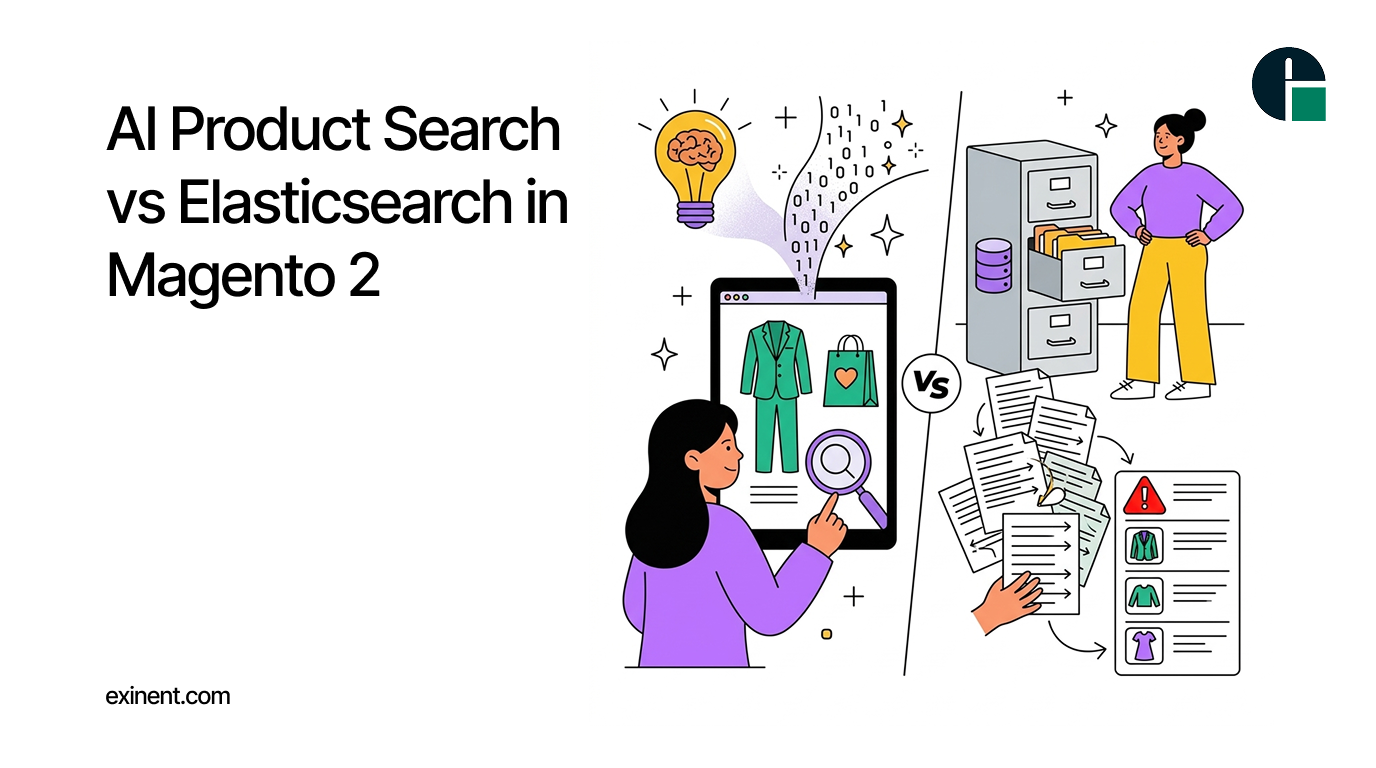
Product search is one of the most important parts of a Magento 2 eCommerce store. Customers often use the search bar when they already know what they want, making search functionality a critical part of product discovery and conversion.
Magento 2 has traditionally relied on Elasticsearch for fast and scalable catalog search. However, as shoppers increasingly use conversational, long-tail, and natural-language queries, AI-powered search is becoming a powerful alternative.
So, how does AI Product Search vs Elasticsearch in Magento 2 compare? Understanding the differences can help merchants decide which approach best fits their store.
What Is Elasticsearch in Magento 2?
Elasticsearch is a search engine designed to provide fast and advanced product catalog searches. Magento and Adobe Commerce use search engines such as Elasticsearch or OpenSearch to process catalog search requests.
Elasticsearch indexes product information such as names, SKUs, descriptions, categories, and attributes. When a customer enters a query, the search engine analyzes the text and retrieves relevant products.
For example, a customer searching for “black running shoes” can receive products containing terms such as “black,” “running,” and “shoes.”
Elasticsearch can also support features such as synonyms, stop words, language analyzers, search suggestions, and relevance configuration.
However, traditional keyword-based search can struggle when customers use conversational language or express their needs in ways that do not directly match catalog data.
What Is AI Product Search?
AI Product Search uses technologies such as Natural Language Processing (NLP), machine learning, semantic search, and intent recognition to understand what a shopper means rather than simply matching words.
For example, consider a customer searching for:
“comfortable waterproof shoes for hiking in rainy weather”
A traditional keyword search may focus on products containing words such as “waterproof,” “shoes,” and “hiking.” An AI search engine can interpret the overall intent and identify products that match the shopper’s requirements, even when the exact wording is not present in the product title.
An example of this approach is Magento AI Product Search, which is designed to understand natural-language queries, product intent, typos, and contextual search requirements.
AI Product Search vs Elasticsearch: Key Differences
1. Keyword Matching vs Search Intent
The biggest difference is how each technology interprets a query.
Elasticsearch primarily works with indexed catalog data and search configuration. Merchants can improve results using synonyms, relevance settings, analyzers, and other configurations.
AI search goes further by attempting to understand the intent behind the query.
For example:
Search query: “office chair for long working hours”
Elasticsearch may look for products containing terms such as “office,” “chair,” and “working.”
AI search can interpret the query as a requirement for an ergonomic or comfortable office chair suitable for extended use.
2. Handling Long-Tail Queries
Long-tail searches can contain multiple requirements.
A shopper might enter:
“lightweight men’s jacket for cold weather under $150”
With traditional search, merchants may need to configure attributes, filters, synonyms, and relevance rules to consistently produce useful results.
AI-powered search can interpret concepts such as gender, product type, use case, weather condition, weight, and price preference together.
This makes AI particularly useful for stores with large catalogs and complex product attributes.
3. Misspellings and Natural Language
Customers do not always search perfectly. They may type:
- “runing shoes”
- “blu tooth headset”
- “watterproof jacket”
- “wireles keyboard”
Traditional search can handle certain spelling variations depending on configuration, but AI-powered search can use language understanding to identify the intended product.
This can reduce frustrating zero-result searches and improve product discovery.
4. Personalization and Product Ranking
Elasticsearch provides powerful tools for controlling relevance and search results. However, merchants may need to configure ranking rules and search settings manually.
AI search can incorporate behavioral signals and intelligent ranking to improve product discovery. Depending on the implementation, it can consider factors such as popularity, product relevance, customer behavior, inventory, or merchandising objectives.
For example, if a shopper searches for “summer dresses,” an intelligent search experience can prioritize relevant seasonal products rather than simply returning products based on keyword frequency.
5. Visual and Multimodal Search
Traditional Elasticsearch-based search is primarily text-oriented.
Modern AI product search can also support visual search. A customer could upload a product image or screenshot and receive visually or semantically similar products.
This can be particularly valuable for fashion, furniture, home décor, automotive parts, and other visually driven industries. Exinent’s AI Product Search, for example, includes image-based search capabilities alongside semantic search.
Is AI Search Replacing Elasticsearch?
Not necessarily.
The choice does not always have to be AI search vs Elasticsearch. In many Magento 2 implementations, AI can work as an intelligent search layer while the underlying Magento catalog and indexing infrastructure continue to play an important role.
Elasticsearch or OpenSearch can remain part of the Magento architecture, while AI enhances how customer queries are interpreted and how products are ranked.
This hybrid approach can provide the benefits of Magento’s established search infrastructure while adding modern capabilities such as semantic understanding and natural-language processing.
It is also important to consider Magento version and hosting environment. Adobe Commerce documentation notes that OpenSearch is the recommended direction for newer Commerce versions, while Elasticsearch support varies by deployment and version.
Which Search Solution Should Magento Stores Choose?
The right solution depends on the store’s requirements.
Elasticsearch or OpenSearch may be suitable when:
- The catalog is relatively straightforward.
- Customers mostly use exact product names or keywords.
- The business wants a native search infrastructure.
- Merchants have technical resources for search configuration.
- Basic synonyms, filters, and relevance rules are sufficient.
AI Product Search may be better when:
- Customers frequently use natural-language queries.
- The store receives many zero-result searches.
- The catalog contains thousands or millions of SKUs.
- Products have complex attributes and specifications.
- Customers frequently make spelling mistakes.
- Product discovery is a major conversion challenge.
- The business wants semantic, personalized, or visual search.
Final Thoughts
The comparison between AI Product Search vs Elasticsearch in Magento 2 is ultimately a comparison between traditional search infrastructure and intelligent search experiences.
Elasticsearch remains a powerful technology for fast catalog search and provides important capabilities for Magento stores. However, AI-powered search can understand customer intent, conversational queries, complex requirements, and other signals that traditional keyword matching may not fully capture.
For Magento merchants looking to improve product discovery and turn more searches into purchases, combining reliable catalog infrastructure with intelligent AI capabilities can provide a more effective search experience.
As shoppers become more comfortable searching with natural language, AI Product Search is increasingly becoming an important competitive advantage for Magento 2 stores.
Explore Magento AI Product Search to learn how AI-powered search can help create a smarter product discovery experience for your Magento store.
FAQ’S :
What is the difference between AI Product Search and Elasticsearch in Magento 2?
AI Product Search uses artificial intelligence to understand user intent, context, synonyms, and natural-language queries. Elasticsearch primarily matches search terms against indexed product data using relevance rules, analyzers, filters, and ranking algorithms. AI search is generally better for conversational and intent-based searches, while Elasticsearch is effective for structured keyword searches.
Is AI Product Search better than Elasticsearch for Magento 2 stores?
AI Product Search can be better for stores with large catalogs, complex product attributes, or customers who use natural-language queries. Elasticsearch remains a strong choice for fast keyword-based product discovery. For many Magento 2 stores, combining AI search with Elasticsearch can provide both intelligent discovery and reliable search performance.
How does AI Product Search improve Magento 2 product discovery?
AI Product Search interprets the meaning behind a query rather than relying only on exact keywords. For example, a search such as “comfortable shoes for rainy weather” can identify relevant products based on attributes such as material, purpose, and product category. This can help customers find suitable products with fewer search attempts.
What are the benefits of Elasticsearch for Magento 2 product search?
Elasticsearch provides fast indexing, keyword matching, filtering, sorting, faceted navigation, and scalable search performance. It is particularly useful for Magento 2 catalogs with many products and attributes. It also supports configurable relevance settings that allow merchants to control how search results are ranked.
Can AI Product Search and Elasticsearch work together in Magento 2?
Yes. AI Product Search and Elasticsearch can be integrated as complementary technologies. Elasticsearch can handle indexing, filtering, and fast retrieval, while an AI layer can interpret natural-language queries, understand intent, and improve result relevance before or during retrieval.
How much does AI Product Search for Magento 2 cost compared with Elasticsearch?
The cost depends on the technology provider, catalog size, search volume, hosting requirements, and integration complexity. Elasticsearch may involve infrastructure and maintenance costs, while AI search can add API, model, or subscription expenses. Businesses should compare total cost of ownership rather than comparing only software or API prices.
What are the risks of using AI Product Search instead of Elasticsearch in Magento 2?
AI search can introduce higher infrastructure or API costs, latency, incorrect interpretations, and less predictable results if product data is poorly structured. Elasticsearch offers more deterministic keyword-based behavior. Testing search accuracy, monitoring zero-result queries, and maintaining high-quality product attributes can reduce these risks.
Which is better for Magento 2: AI search or Elasticsearch?
There is no single best option for every Magento 2 store. Elasticsearch is suitable for traditional keyword search and structured catalog navigation, while AI Product Search is stronger for semantic and natural-language discovery. Stores should choose based on catalog complexity, customer search behavior, budget, and required search experience.
What is the best way to implement AI Product Search in Magento 2?
Start by analyzing internal search queries, zero-result searches, product attributes, and conversion data. Then define relevant use cases, integrate the AI search layer with the Magento catalog, test results against Elasticsearch, and continuously monitor search accuracy and conversion metrics. A hybrid AI-plus-Elasticsearch approach can be effective for complex Magento stores.