
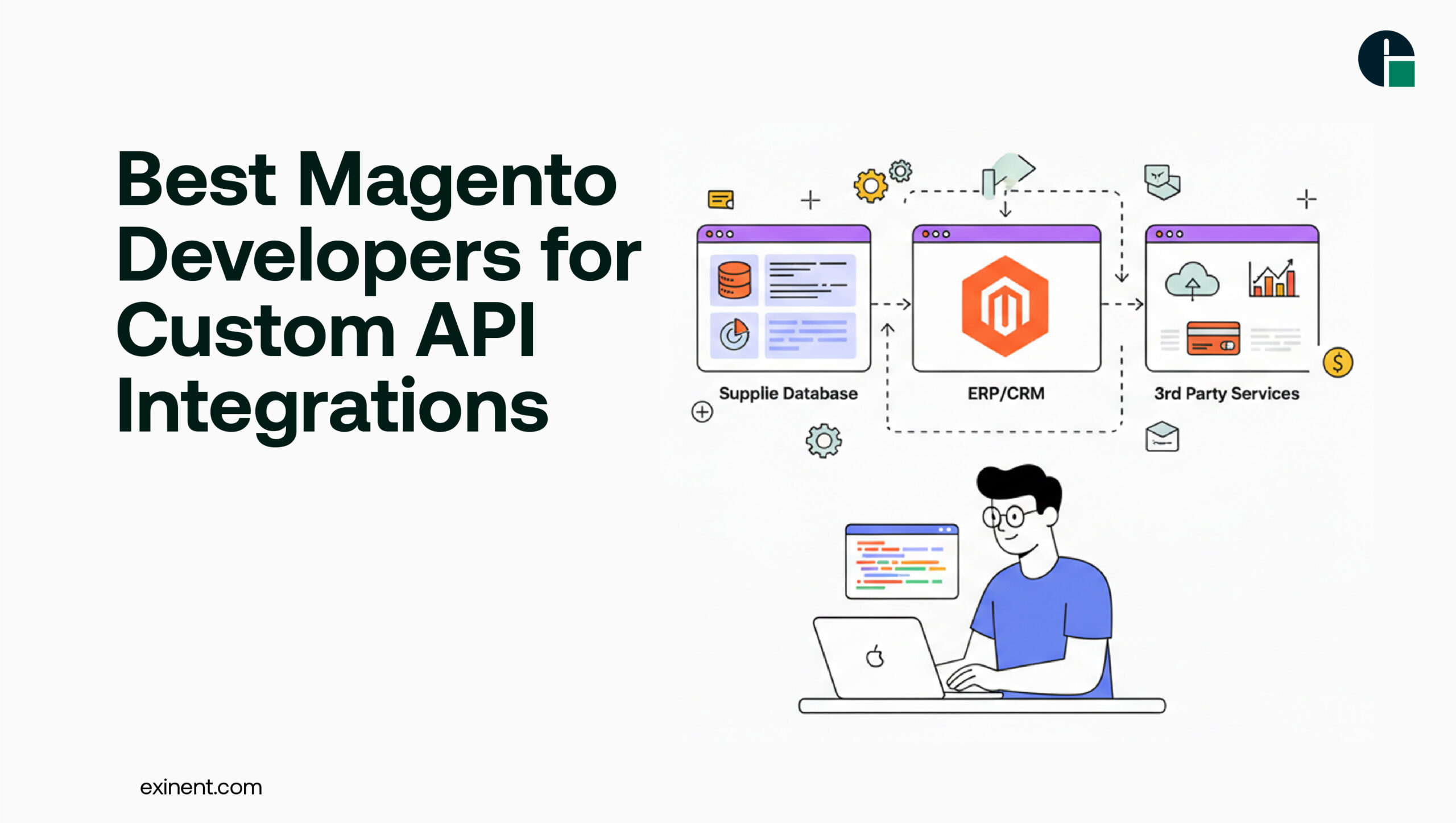
When running an e-commerce business on Magento — whether the open-source version or Adobe Commerce — there often comes a time when its out-of-the-box APIs aren’t enough. You need custom endpoints to integrate with third-party systems (ERP, CRM, mobile apps), or to expose tailored business logic. But not all Magento developers are equally capable of doing this well. So who should you trust for custom Magento APIs — and how do you identify them? In this blog, I’ll walk you through what makes top-tier Magento API developers, where to look, and what to demand from them.
Why Custom Magento APIs Matter
Magento already offers native support for REST, SOAP (and more recently GraphQL) — enough for standard operations like retrieving product lists, customer data, or updating orders.
But real-world commerce ecosystems often demand more:
- Synchronizing orders with a custom ERP or warehouse system.
- Providing a mobile app backend to support features not covered by default endpoints.
- Enabling complex business logic — e.g. promotional engines, custom tax or discount rules, dynamic pricing.
- Integrating third-party services (shipping providers, CRM, analytics, external databases).
Custom APIs unlock Magento’s real power — provided they’re built properly, following best practices in architecture, security, and performance.
That’s why choosing the right Magento developers (or a team) matters enormously.
What Skills and Qualities Define “Best” Magento API Developers
Here are the characteristics to evaluate when hiring developers or a team for custom Magento APIs:
- Strong PHP, MySQL, and Magento architecture understanding.
Magento is built on PHP, and its modular architecture demands adherence to its design patterns (dependency injection, modules, etc.). Knowing MySQL (or MariaDB) and Magento’s entity-attribute-value (EAV) paradigm is essential. - Proficiency with Magento’s API framework (REST/SOAP/GraphQL) and custom module creation.
Creating custom API endpoints requires building custom modules (module.xml, registration.php), defining webapi.xml, interfaces, controllers or service classes, ACL and permissions, etc. - Good code quality and adherence to coding standards.
Clean, maintainable, testable code (unit testing, proper documentation, code comments), version control (Git), staging environment, and adherence to Magento conventions helps in long-term maintainability. - Performance optimization and scalability awareness.
Custom APIs must handle data loads efficiently, design endpoints to avoid heavy database queries, manage caching, and avoid performance bottlenecks. 2 - Security best practices + robust authentication & authorization.
Magento supports token-based auth, OAuth, role-based permissions. A good developer ensures that custom APIs don’t expose vulnerabilities, follow permission rules, and secure sensitive data. - Strong communication, documentation, and after-launch support.
Building APIs is not just coding — it involves understanding business needs, documenting endpoints, supporting integrations, and maintaining or updating as requirements evolve. - Hands-on experience with real API integrations.
A developer may know Magento theoretically, but the best ones have a proven track record of building and maintaining custom APIs, integrating with third-party systems, and handling edge cases (bulk data, rate limits, error handling).
Where to Find Reliable Magento API Developers (or Teams)
If you’re looking for a professional team to handle custom Magento API work, consider:
- Companies branding themselves as a “magento development company” — these often have full-time teams and a process to handle complex projects. For instance, check out a reputable firm at magento development company.
- Vendors serving clients globally, especially “magento development company in USA” background — they are often experienced with larger, enterprise-grade stores and cross-border integrations. Example: magento development company in USA.
- Freelancers or small teams — but only if you verify their credentials carefully. Ask for past projects involving custom APIs, references, and demonstration of secure, maintainable code.
- Open-source contributors — developers who contribute to Magento core or popular extensions tend to understand the platform deeply.
Questions to Ask Before Hiring a Magento API Developer
When evaluating candidates or companies, consider asking:
- Which Magento versions have you worked on? Experience with both Magento 1 and Magento 2 (or newer) helps, especially in migration or multi-version maintenance contexts.
- Can you show examples of custom APIs you’ve built (with code / docs / endpoints)? Real-world code or documentation is better than verbal assurance.
- How do you manage version control, testing, staging, deployments and post-launch support? Ask about Git, test environments, code reviews, rollback strategies.
- How do you handle performance for bulk data or high traffic? Good developers should know about caching, load optimization, endpoint efficiency.
- What security measures do you follow for API endpoints and integrations? Token auth, ACL permissions, data sanitization, encryption for sensitive data, etc.
- Will you document the APIs, provide a spec (Swagger / OpenAPI), and hand over docs? This matters — especially for future maintenance or when other developers need to use those APIs.
Why Many Clients Choose Specialized Magento Agencies
Working with a dedicated agency — especially one that markets itself as a full-service “magento development company” — has advantages:
- Teams with diverse skills: back-end developers, testers, DevOps, project managers.
- Formal process: requirements gathering → module design → API development → testing → deployment → maintenance.
- Accountability and support: agencies often provide service-level commitments, support packages, and documentation.
- Reduced risk: better code quality, clean architecture, fewer security issues, and fewer surprises down the line.
Especially for complex stores or integrations (ERP, omnichannel, mobile front-ends), an agency approach tends to pay off more than hiring freelance developers ad hoc.
What to Avoid — and Common Red Flags
- Developers who can’t show real-world API work or only have front-end/theme customization experience.
- Lack of version control, messy repository history, or no code reviews.
- No documentation or poor documentation of APIs (makes long-term maintenance hard).
- Poor communication, especially across time zones or with remote teams — this leads to misunderstandings in business requirements vs. code output.
- Ignoring staging/testing environment, or skipping QA and testing phases — this can introduce bugs or break store features.
- Not following Magento’s coding standards or security best practices.
Conclusion: Choose Developers Who Combine Magento Mastery with API Expertise
If you aim to harness Magento’s flexibility — from ERP integration to custom mobile apps, advanced business logic, or third-party system connectivity — custom APIs are often your gateway. But only skilled Magento developers, comfortable with PHP, database design, Magento architecture, API frameworks, performance tuning, security and documentation can deliver reliable, scalable APIs.
For many projects, working with a well-established magento development company — preferably one with international exposure, like a magento development company in USA — helps ensure professionalism, scalability, and long-term maintainability.
FAQ’s :
1. Who are the best Magento developers for custom API integrations?
The best Magento developers for custom API integrations are teams with proven experience in building REST, GraphQL, and third-party API connections specifically for Magento 2. Look for certified developers, agencies with strong portfolios, and those specializing in complex integrations like ERP, CRM, and PIM systems.
2. What does a Magento developer do when building a custom API?
A Magento developer analyzes your data needs, defines endpoints, writes custom modules, and ensures secure authentication. They also test API performance, validate responses, and document the integration for long-term maintenance.
3. How do I choose the right Magento developer for custom APIs?
Choose developers who have experience with Magento 2 architecture, API frameworks, and real-world integration use cases. Check their certifications, case studies, response times, and ability to scale APIs for high-traffic stores.
4. What are the benefits of hiring Magento experts for custom API development?
Expert developers ensure faster integration, lower error rates, and better compatibility with Magento’s core modules. They also create scalable endpoints that improve automation across systems like inventory, shipping, and marketing tools.
5. How much does custom API development for Magento typically cost?
Custom API work usually costs between $1,000 and $10,000 depending on the complexity, number of endpoints, and system integrations required. Enterprise-level API builds can be higher due to authentication layers, custom logic, and testing.
6. How long does it take to build a custom Magento API?
Simple API endpoints may take 1–2 weeks, while complex multi-system integrations can take 4–12 weeks. Timelines vary based on data mapping, authentication needs, and testing cycles.
7. What risks should I consider when building custom APIs for Magento?
Common risks include security vulnerabilities, performance slowdowns, and conflicts with Magento core updates. Hiring experienced developers reduces these risks through proper code structure, version control, and testing.
8. Are custom Magento APIs worth it for growing eCommerce stores?
Yes, custom APIs help automate workflows, sync data in real time, and reduce manual work. They also support scaling by connecting Magento with ERPs, CRMs, marketplaces, and marketing platforms.
9. What types of systems can Magento developers connect with using custom APIs?
Developers can integrate ERP systems, CRMs, PIMs, POS systems, shipping platforms, and marketplace APIs. Most integrations use REST or GraphQL, depending on data requirements.
10. Can custom APIs slow down my Magento store?
Poorly optimized APIs can slow your store, but well-built endpoints maintain performance. Developers use caching, optimized queries, and asynchronous processing to keep the site fast.