
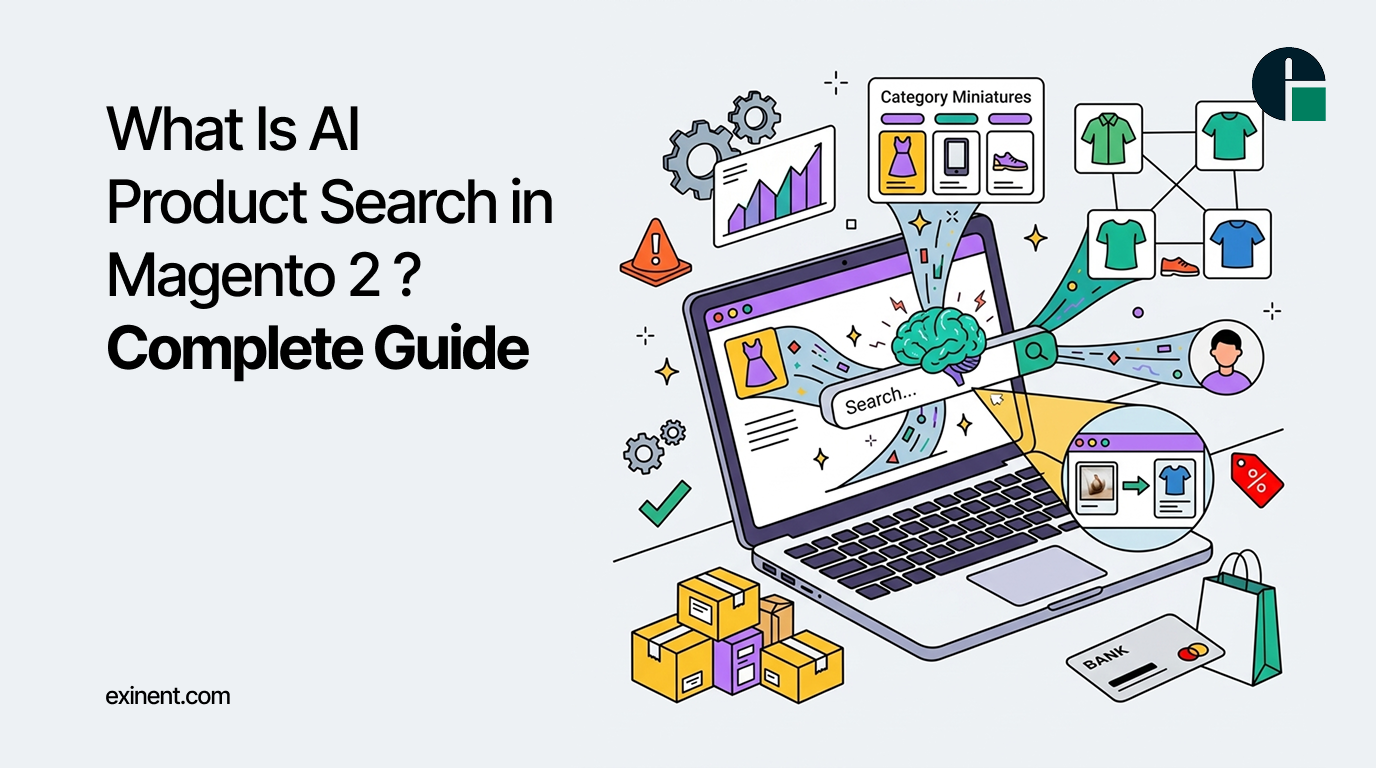
In modern eCommerce, customers expect to find the right product quickly, even when they do not know the exact product name, SKU, or terminology used by a store. This is where AI Product Search in Magento 2 can make a major difference.
Traditional Magento search generally depends on keyword matching. If a shopper types a phrase that does not closely match the product catalog, the search engine may return irrelevant products or no results at all. AI-powered search takes a different approach: it analyzes the meaning, intent, context, and relationships behind a shopper’s query to provide more relevant results.
Adobe Commerce’s current semantic search capabilities similarly use AI to understand shopper intent rather than relying only on exact words.
What Is AI Product Search in Magento 2?
AI Product Search is an intelligent search solution that uses technologies such as artificial intelligence, machine learning, Natural Language Processing (NLP), and semantic search to improve product discovery in a Magento 2 store.
Instead of simply asking, “Does the product contain these exact words?”, AI search attempts to understand what the customer actually wants.
For example, a customer might search for:
- “comfortable shoes for walking all day”
- “warm jacket for winter travel”
- “black office chair under $200”
- “waterproof shoes for hiking”
- “gift for a coffee lover”
A conventional keyword search may struggle with these conversational queries. AI search can interpret the intent behind them and connect the query with relevant product attributes, descriptions, categories, prices, and other catalog information.
For Magento merchants interested in upgrading their storefront search experience, Magento AI Product Search can provide an intelligent way to improve product discovery.
How Does AI Product Search Work in Magento 2?
AI product search typically works through several stages.
1. Product Catalog Analysis
The AI system first processes information from the Magento catalog, including product names, descriptions, categories, attributes, brands, and other relevant data.
This gives the search system a better understanding of what products are available.
2. Understanding Customer Intent
When a shopper enters a query, AI analyzes the words and their context. Rather than treating every word independently, semantic search looks at the overall meaning of the request.
For instance, “shoes for trail running” could be matched with products described as hiking or off-road footwear even if the exact phrase “trail running” does not appear in the product title. Adobe describes this type of semantic matching as a way to connect different wording with the underlying shopping intent.
3. Matching Products
The AI compares the customer’s query with the information it has learned from the product catalog. It can then identify products that are semantically relevant instead of depending entirely on exact keyword matches.
4. Ranking Results
Relevant products can be ranked so that shoppers see the most useful options first. Modern AI-powered commerce search can combine semantic understanding with traditional keyword matching, filters, merchandising rules, and other ranking signals.
AI Product Search vs. Traditional Magento Search
The biggest difference is intent understanding.
Traditional search might interpret:
“blue running shoes”
as a request for products containing the words “blue,” “running,” and “shoes.”
AI search can go further by understanding that the shopper wants a specific type of footwear, color, and potentially other characteristics expressed through natural language.
AI-powered search can also help with:
- Synonyms and alternative terminology
- Conversational searches
- Long-tail queries
- Misspellings
- Product attributes
- Context-based searches
- Semantic relationships between products and queries
This can reduce frustrating “no results found” situations and help customers discover products more naturally.
Key Benefits of AI Product Search for Magento 2 Stores
Better Product Discovery
Customers can describe what they need in their own words rather than learning the exact terminology used in your catalog.
Fewer Zero-Result Searches
When search understands meaning instead of only matching exact phrases, shoppers have a better chance of finding relevant products.
Improved Customer Experience
Fast and relevant search reduces the effort customers need to find products, creating a smoother shopping journey.
Higher Conversion Opportunities
When customers find relevant products faster, they are more likely to continue browsing, add products to their cart, and complete purchases.
Less Manual Synonym Management
Traditional search optimization may require merchants to maintain extensive synonym lists. Semantic search can automatically recognize many relationships between different terms.
Support for Large Product Catalogs
AI search can be particularly valuable for Magento stores with thousands or millions of SKUs, where manually optimizing every search term becomes increasingly difficult.
What Data Does AI Product Search Need?
The quality of AI search depends heavily on the quality of the product catalog. Useful information can include:
- Product names
- Product descriptions
- Categories
- Brands
- Product attributes
- Sizes and colors
- Materials
- Technical specifications
- Pricing
- Inventory information
- Search and behavioral signals
Clear, descriptive product information gives AI more context to understand both products and customer searches. Adobe also recommends maintaining detailed product names and descriptions to support stronger keyword and semantic matching.
Why AI Search Matters for Magento 2 Businesses
Search is more than a navigation feature. It is an important part of the buying journey because shoppers who use search often have a clear idea of what they want.
If the search experience fails, customers may leave the website instead of exploring multiple pages. AI-powered search helps turn this interaction into an opportunity to guide shoppers toward relevant products.
For Magento merchants, an intelligent search experience can also provide useful insights into customer behavior, including popular queries, zero-result searches, and product discovery trends. Solutions such as Exinent AI Product Search are designed to combine intelligent search with analytics and merchandising capabilities.
Final Thoughts
AI Product Search in Magento 2 represents a shift from basic keyword matching to intelligent, intent-driven product discovery. Instead of forcing customers to search using the exact language found in a product catalog, AI allows them to communicate more naturally.
By understanding context, synonyms, long-tail phrases, and shopping intent, AI search can help Magento stores deliver more relevant results, fewer zero-result searches, faster product discovery, and a better overall customer experience.
As eCommerce continues moving toward personalized and conversational shopping, upgrading Magento 2 search with AI can become an important competitive advantage for businesses looking to improve product discovery and increase conversion opportunities.
FAQ’S :
What Is AI Product Search in Magento 2?
AI product search in Magento 2 uses artificial intelligence to understand customer queries and return more relevant products. Unlike traditional keyword search, it can interpret natural-language searches, synonyms, product attributes, and customer intent to improve product discovery.
How Does AI Product Search Work in Magento 2?
AI product search processes a shopper’s query, identifies its intent and relevant attributes, and matches it with product catalog data. A typical implementation involves 3 steps: connecting catalog data, indexing product information, and using an AI search model to rank relevant results.
What Are the Benefits of AI-Powered Product Search for Magento 2 Stores?
AI-powered search can improve product relevance, help shoppers find products faster, and reduce searches that return no results. It can also understand conversational queries and synonyms that conventional Magento 2 keyword search may not recognize.
How Is AI Product Search Different From Magento 2 Default Search?
Magento 2’s default search primarily relies on indexed keywords and configured search settings, while AI search can interpret meaning, context, and natural-language intent. For example, an AI search may understand “comfortable shoes for long walks” and match products based on attributes such as cushioning and intended use.
What Product Data Does Magento 2 AI Search Need?
AI search typically uses product names, descriptions, categories, attributes, SKUs, prices, and inventory information. The quality and completeness of this catalog data directly affect search relevance, so product attributes and descriptions should be accurate and consistently structured.
How Can I Implement AI Product Search in Magento 2?
Start by evaluating your current Magento search performance and defining the queries you want AI to improve. Then connect the product catalog to an AI search solution, configure indexing and ranking, test common customer queries, and monitor search performance after deployment.
How Much Does AI Product Search for Magento 2 Cost?
The cost depends on the AI search solution, catalog size, search volume, integration complexity, and required customization. Expenses may include the search platform or API, Magento 2 development, data indexing, infrastructure, and ongoing maintenance.
Is AI Product Search Worth It for a Magento 2 Store?
AI product search can be worthwhile for stores with large catalogs, complex product attributes, or frequent unsuccessful searches. Before implementation, compare metrics such as zero-result searches, search conversion rate, click-through rate, and revenue from search to establish a measurable business case.
What Are the Risks of Using AI Product Search in Magento 2?
Common risks include inaccurate results, outdated catalog information, higher API or infrastructure costs, and unexpected AI-generated interpretations. Stores should validate search results, synchronize product data regularly, apply clear ranking rules, and monitor search queries to identify errors.
What Are the Best Practices for AI Product Search in Magento 2?
Use clean product data, well-defined attributes, relevant synonyms, and regular catalog synchronization. Test AI search with real customer queries and track metrics such as zero-result rate, search conversion rate, and product click-through rate to continuously improve relevance.