
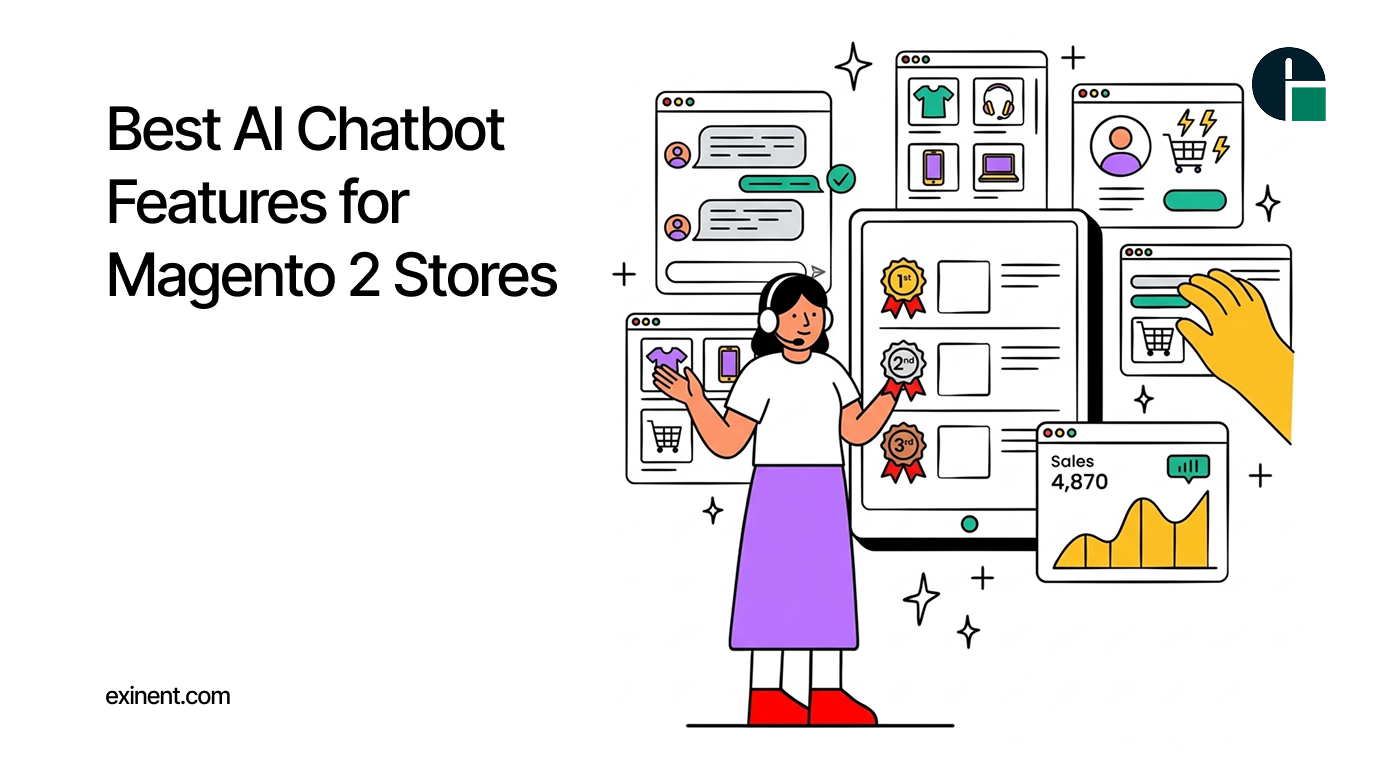
Ecommerce customers expect fast, personalized, and convenient shopping experiences. When shoppers have questions about products, availability, shipping, returns, or orders, even a short delay can create friction and lead to abandoned purchases. For Magento 2 stores, an AI chatbot can help address these challenges by combining conversational assistance with product, catalog, and customer information.
Modern Magento AI chatbots are moving beyond simple FAQ automation. They can support product discovery, provide personalized recommendations, answer order-related questions, and, in more advanced implementations, assist shoppers with cart and checkout activities. Adobe is also expanding conversational and agentic commerce capabilities around real-time commerce data and tools.
Here are the best AI chatbot features for Magento 2 stores that businesses should consider.
1. Natural Language Understanding
One of the most important chatbot features is the ability to understand customers’ questions in natural language.
Instead of requiring shoppers to search for exact keywords, an AI chatbot can understand requests such as:
- “Show me black running shoes under $100.”
- “Which laptop is best for graphic design?”
- “Do you have this shirt in medium?”
- “I need a waterproof jacket for hiking.”
Natural language understanding makes product discovery more conversational and reduces the effort customers need to find what they want.
2. AI-Powered Product Search
Magento stores can have thousands of products, categories, attributes, and variations. Traditional keyword search may not always understand what shoppers actually mean.
An AI chatbot with semantic or conversational product search can interpret shopping intent and identify relevant products based on attributes, categories, price ranges, and product information. Current Magento chatbot implementations commonly support natural-language product discovery and attribute-based filtering.
This feature can make the chatbot function as an intelligent shopping assistant rather than simply a customer-service tool.
3. Personalized Product Recommendations
Personalization is another valuable feature for Magento 2 AI chatbots.
A chatbot can recommend products based on the customer’s current conversation, shopping requirements, cart contents, or available product information. For example, when a customer asks about a camera, the chatbot could suggest compatible lenses, memory cards, batteries, or accessories.
Personalized recommendations can help customers discover relevant products while creating opportunities for cross-selling and upselling. Adobe Commerce also emphasizes personalization across product discovery, promotions, and customer touchpoints.
4. Real-Time Product and Inventory Information
Customers don’t want recommendations for products that are unavailable.
A Magento-focused chatbot should ideally connect with current store data so it can provide relevant information about product availability, variations, pricing, and other catalog details. Some Magento AI chatbot solutions specifically integrate stock levels, product variations, and catalog information into conversations.
For example, instead of saying, “This product may be available,” the chatbot can provide a more useful response based on the store’s current data.
5. Order Tracking and Customer Account Support
AI chatbots can also automate common post-purchase questions.
Customers frequently ask:
- “Where is my order?”
- “Has my order shipped?”
- “Can I see my invoice?”
- “What was my previous order?”
- “What is the status of my delivery?”
With appropriate Magento integration and authentication, a chatbot can help customers access order-related information without requiring them to navigate through multiple account pages. Existing Magento chatbot implementations support order summaries, tracking, and customer account-related queries.
This can reduce repetitive work for customer support teams.
6. Cart and Checkout Assistance
The most advanced AI chatbot experiences don’t stop at product recommendations. They can help customers take actions directly within the shopping journey.
Depending on the implementation, a chatbot may help shoppers add products to their cart, adjust quantities, apply promotions, review their cart, and move toward checkout. Adobe’s current Commerce MCP vision includes conversational product discovery, context-aware sessions, bidirectional cart management, and conversational checkout.
This creates a shorter path from question → product → cart → purchase.
7. Context-Aware Conversations
Customers don’t always ask complete questions.
A shopper might say:
Customer: “Show me blue backpacks.”
Chatbot: “Here are several options.”
Customer: “Which one is waterproof?”
A basic chatbot may not understand what “which one” refers to. A context-aware AI chatbot can retain relevant conversation history and understand follow-up questions.
This creates a more natural experience and eliminates the need for customers to repeat themselves.
8. Multilingual Customer Support
Magento stores often serve customers across different regions and countries. Multilingual AI chatbot support can help businesses communicate with shoppers in their preferred languages.
Instead of maintaining separate teams for every language, businesses can use AI to handle common product and support conversations across multiple languages, depending on the chatbot’s capabilities and configuration.
This can be particularly useful for Magento stores operating multiple websites or international storefronts.
9. Knowledge Base and FAQ Integration
A chatbot should understand more than product information.
Businesses can connect relevant knowledge sources such as:
- FAQs
- Shipping policies
- Return policies
- Warranty information
- CMS pages
- Product documentation
- Store policies
- Blog content
Some Magento AI chatbot solutions support CMS and document-based knowledge so the assistant can answer questions using business-specific content.
This helps ensure that responses are more relevant to the individual store.
10. Human Agent Handoff
AI shouldn’t be expected to solve every customer issue.
When a question involves a complaint, complicated return, payment issue, or situation requiring human judgment, the chatbot should be able to transfer the conversation to a customer service representative.
A good implementation should make the transition smooth and preserve relevant conversation context where possible. This allows AI to handle repetitive questions while human agents focus on complex customer needs.
11. Analytics and Conversation Insights
Another important feature is chatbot analytics.
Store administrators should be able to understand:
- What customers are asking
- Which products generate the most questions
- Which questions remain unanswered
- How often customers interact with the chatbot
- Which conversations lead to conversions
- Where customers require human assistance
These insights can reveal gaps in product information, FAQs, navigation, and customer support.
12. Security and Data Privacy
Security should be a priority when implementing an AI chatbot for Magento 2.
If the chatbot can access customer accounts, orders, addresses, carts, or other sensitive information, proper authentication, permissions, data handling, and access controls are essential. Businesses should also understand how their selected AI provider processes and stores information.
A well-designed chatbot should provide useful personalization without exposing information that a customer is not authorized to access.
Why Choose a Magento-Specific AI Chatbot?
A generic AI chatbot may answer general questions, but an ecommerce chatbot needs access to relevant store context. A Magento-focused solution can be designed around products, categories, attributes, inventory, customer accounts, carts, orders, and store policies.
For businesses exploring these capabilities, a dedicated Magento AI Chatbot can help combine AI-powered conversations with Magento ecommerce workflows.
Final Thoughts
The best AI chatbot for a Magento 2 store should do more than display automated answers. It should act as an intelligent shopping assistant that understands customer intent, finds relevant products, provides accurate store information, supports customers after purchase, and helps move shoppers toward conversion.
Features such as natural language search, personalized recommendations, real-time catalog information, order tracking, context-aware conversations, multilingual support, cart assistance, analytics, and human handoff can make an AI chatbot a valuable part of the Magento customer experience.
As conversational commerce continues to evolve, Magento merchants that invest in intelligent, secure, and well-integrated chatbot experiences can create faster and more convenient shopping journeys while reducing repetitive customer support workloads.
FAQ’S :
What are the best AI chatbot features for Magento 2 stores?
The best AI chatbot features for Magento 2 stores include product recommendations, natural-language search, order tracking, FAQs, cart assistance, multilingual support, and personalized responses. The chatbot should also integrate with Magento 2 product, customer, inventory, and order data to provide accurate information.
How can an AI chatbot improve the Magento 2 shopping experience?
An AI chatbot can help shoppers find products, compare options, answer questions, and resolve common issues without navigating multiple pages. It can provide 24/7 assistance and reduce friction during product discovery, checkout, and post-purchase support.
Which Magento 2 AI chatbot features are most important for product recommendations?
Product search, personalized recommendations, product comparison, attribute-based filtering, and real-time inventory information are key features. The chatbot should understand requests such as “Show me black running shoes under $100” and return relevant products based on catalog data.
Can a Magento 2 AI chatbot help with order tracking and customer support?
Yes. When integrated with Magento 2 order data, an AI chatbot can provide order status, shipping information, delivery updates, and basic return or cancellation guidance. This can automate repetitive support questions while allowing complex issues to be transferred to human agents.
What are the benefits of using a multilingual AI chatbot in Magento 2?
A multilingual AI chatbot allows Magento 2 stores to assist customers in different languages without maintaining separate support teams for every language. It can translate product information, answer common questions, and provide support based on the shopper’s preferred language.
How does an AI chatbot integrate with a Magento 2 product catalog?
Integration typically involves connecting the chatbot to Magento 2 through APIs, extensions, or custom middleware. The system retrieves relevant catalog information such as product names, descriptions, prices, attributes, categories, stock status, and availability to generate context-aware responses.
How much does it cost to add an AI chatbot to a Magento 2 store?
The cost varies based on chatbot complexity, AI model usage, Magento integration requirements, customization, and ongoing maintenance. A basic FAQ chatbot generally costs less than an advanced solution with product recommendations, order tracking, customer personalization, and multiple system integrations.
What are the risks of using an AI chatbot on a Magento 2 store?
Common risks include inaccurate product information, outdated inventory data, privacy issues, unauthorized access, and inappropriate AI-generated responses. Stores should use controlled data sources, secure API access, human escalation, monitoring, and regular testing to reduce these risks.
What are the best practices for implementing an AI chatbot in Magento 2?
Start with high-volume customer questions and connect the chatbot to reliable Magento 2 data sources. Test product recommendations and transactional responses, protect customer data, monitor chatbot conversations, provide human escalation, and regularly update the knowledge base and product information.