
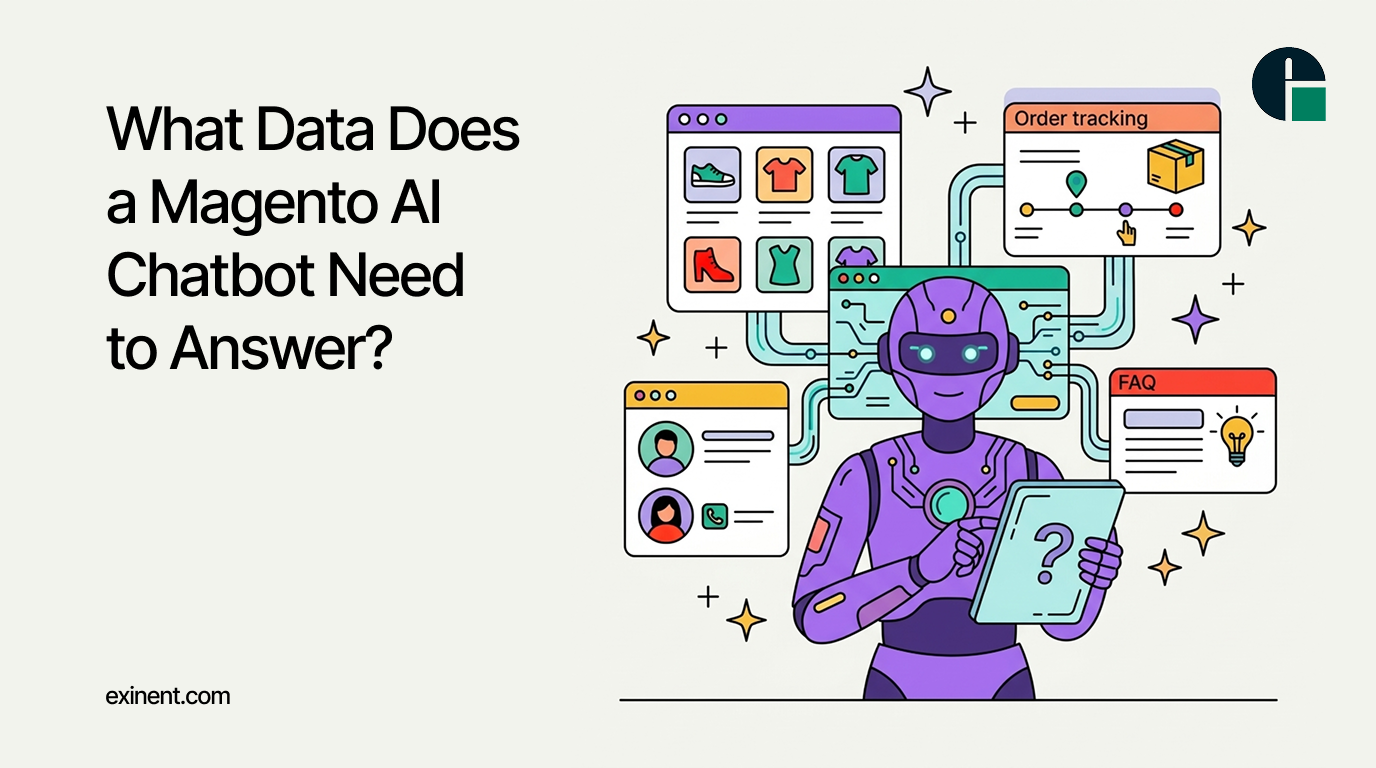
An AI chatbot can make a Magento store much more helpful by answering customer questions instantly, recommending products, and assisting shoppers throughout their buying journey. But an AI chatbot is only as useful as the data it can access.
For a Magento AI chatbot to provide accurate, relevant, and trustworthy answers, it needs access to the right combination of product, customer, order, store, and conversational data. At the same time, sensitive information must be protected through proper authentication and access controls.
Here’s a closer look at the data a Magento AI chatbot needs and how each type contributes to better customer support.
1. Product Catalog Data
Product information is the foundation of an eCommerce chatbot. Customers frequently ask questions such as:
- What features does this product have?
- Is this available in blue?
- What are its dimensions?
- Is this product compatible with another item?
- Do you have something similar at a lower price?
To answer these questions, the chatbot needs access to relevant catalog information, including:
- Product names and SKUs
- Descriptions
- Short descriptions
- Product attributes
- Specifications
- Dimensions and weight
- Materials
- Colors and sizes
- Product categories
- Related and complementary products
- Product images and URLs
- Pricing information
The more complete and accurate the product catalog is, the better the chatbot can understand natural-language questions and recommend suitable products.
A well-configured Magento AI Chatbot can use this information to turn complicated product searches into simple conversations.
2. Inventory and Availability Data
Customers don’t just want to know whether a product exists—they want to know whether they can buy it now.
Inventory data allows the chatbot to answer questions such as:
- Is this item in stock?
- Do you have this size available?
- When will this product be back in stock?
- How many units are available?
This information is particularly important for stores with frequently changing inventory.
However, there is an important distinction between static product information and live inventory data. A chatbot that only accesses product descriptions may know that a product comes in a particular size but may not know whether that size is currently available. For accurate availability answers, the chatbot needs access to current inventory information.
3. Pricing and Customer-Specific Pricing
Price is one of the most common topics customers ask about.
The chatbot may need access to:
- Current product prices
- Special prices
- Sale prices
- Tier pricing
- Customer-group pricing
- Currency information
- Applicable promotions
This becomes particularly important for B2B Magento stores, where different customer groups may receive different prices.
Providing the chatbot with outdated pricing can create confusion and damage customer trust. Therefore, pricing information should be synchronized frequently or retrieved dynamically from Magento when appropriate.
4. Category and Store Structure
Product categories help the chatbot understand how products are organized.
For example, a shopper might ask:
“Show me running shoes suitable for beginners.”
The chatbot can use category information, product attributes, and product relationships to narrow down the results.
Category data can include:
- Category names
- Category descriptions
- Subcategories
- Category URLs
- Products assigned to categories
- Category-specific attributes
This helps customers discover products even when they don’t know the exact product name or SKU.
5. CMS, FAQ, and Policy Information
Not every customer question is about a product.
Customers also ask:
- What is your return policy?
- How long does shipping take?
- Do you offer international delivery?
- How can I cancel an order?
- What payment methods do you accept?
- Do you provide warranties?
For these questions, the chatbot needs access to your store’s CMS pages, FAQs, shipping information, return policies, warranty terms, and other support documentation.
Some Magento chatbot implementations use products, categories, CMS pages, and support topics as training or retrieval data.
Keeping this information updated is essential. If your return policy changes but the chatbot still relies on an old version, it could provide incorrect answers.
6. Customer Account Data
For personalized support, a chatbot may need limited access to customer account information.
Depending on the use case, this could include:
- Customer name
- Account information
- Customer group
- Saved addresses
- Wishlist
- Cart contents
- Previous purchases
Magento allows authenticated customers to access information associated with their own accounts through APIs. Its authentication framework controls which resources a caller can access.
Importantly, a chatbot should not automatically receive unrestricted access to all customer information. It should only access the minimum data necessary to answer the customer’s question.
7. Order and Shipment Data
Order-related questions require a different type of information.
For example:
- Where is my order?
- Has my order shipped?
- What is my tracking number?
- What products did I purchase?
- Can I reorder an item?
To answer these questions, the chatbot may need access to:
- Order number
- Order date
- Ordered products
- Order status
- Shipment status
- Tracking information
- Invoice details
- Delivery information
Magento customer accounts already provide self-service capabilities such as viewing current and past orders.
Because order data is sensitive, authentication and customer verification are critical. A chatbot should never reveal one customer’s order information to another shopper.
8. Shopping Cart Data
Cart context can make conversations much more useful.
Imagine a customer asks:
“Is there a case that fits the phone in my cart?”
If the chatbot can access the cart, it can understand what product the customer is considering and provide a more relevant recommendation.
Cart data may include:
- Products
- Quantities
- Selected variants
- Prices
- Applied discounts
- Cart totals
This allows the chatbot to provide contextual recommendations rather than generic product suggestions.
9. Conversation History
AI chatbots also need conversational context.
Consider this interaction:
Customer: “Show me black backpacks.”
Chatbot: “Here are five options.”
Customer: “Which one is waterproof?”
Chatbot: “The second and fourth options are waterproof.”
The chatbot needs the previous conversation to understand what “which one” refers to.
Conversation history can help with:
- Follow-up questions
- Product comparisons
- Clarifications
- Contextual recommendations
- Multi-step shopping journeys
However, businesses should define appropriate retention periods and avoid storing unnecessary personal information.
10. Data Security and Access Controls
Giving an AI chatbot access to Magento data doesn’t mean giving it access to everything.
A secure implementation should use:
- Authentication
- Authorization
- Restricted API permissions
- Customer verification
- Data minimization
- Secure API connections
- Appropriate logging
- Protection of sensitive customer information
Adobe Commerce’s API framework supports resource-based permissions, allowing integrations to access only authorized resources.
This is especially important when the chatbot can access customer accounts, orders, addresses, or other private information.
How Much Data Does a Magento AI Chatbot Actually Need?
The answer depends on what you want the chatbot to do.
For a basic product assistant, product catalog, categories, FAQs, and CMS content may be enough.
For a customer support chatbot, you’ll likely need shipping, returns, payment, and policy information.
For a personalized shopping assistant, product, pricing, inventory, cart, customer, and conversation data become more important.
For an order-support assistant, authenticated access to order and shipment information is essential.
The goal isn’t to give the AI access to every piece of Magento data. Instead, provide relevant, accurate, current, and appropriately permissioned data for each task.
Final Thoughts
A Magento AI chatbot needs more than a collection of FAQs to deliver useful customer experiences. Product data helps it answer shopping questions, inventory data helps it provide availability information, customer and order data enable personalization, while CMS and policy content support general customer service.
The most effective approach is to connect the chatbot to reliable Magento data sources and carefully control what information it can access. With the right data architecture, your Magento AI Chatbot can move beyond basic automated replies and become a genuinely useful shopping and customer-support assistant.
The key principle is simple: better data leads to better answers—but secure, relevant data leads to better answers customers can trust.
FAQ’S :
What data does a Magento AI chatbot need to answer customer questions?
A Magento AI chatbot typically needs product information, pricing, inventory, categories, customer FAQs, shipping policies, return rules, and order data. It may also use customer account information and store-specific knowledge to provide personalized answers.
How does a Magento AI chatbot use product catalog data?
The chatbot uses product names, descriptions, SKUs, attributes, categories, prices, images, and availability to answer product-related questions. This data helps customers find products, compare options, and understand specifications using natural-language queries.
Does a Magento AI chatbot need real-time inventory and pricing data?
Yes, real-time or frequently synchronized inventory and pricing data is important when customers ask about product availability or current prices. Connecting the chatbot to Magento ensures answers reflect the latest store information and reduces outdated responses.
What customer data does a Magento AI chatbot need for personalized support?
For personalized support, a chatbot may need customer account details, order history, shipping status, cart contents, and previous support interactions. Access should be limited to the information required for the specific task and protected using appropriate security controls.
Can a Magento AI chatbot answer questions using store policies and FAQs?
Yes. A chatbot can use structured FAQs and documents covering shipping, returns, refunds, warranties, payment methods, and other store policies. Keeping this information accurate and updated helps the chatbot provide consistent answers.
What order data does a Magento AI chatbot need for order tracking?
For order-related questions, the chatbot generally needs an order number or authenticated customer account along with order status, payment status, shipment details, tracking information, and delivery updates. Customer authentication should be used before exposing private order information.
How is Magento data connected to an AI chatbot?
Magento data can be connected through APIs, database integrations, extensions, or scheduled data synchronization. A typical setup imports product and policy information into the chatbot’s knowledge system while using live Magento data for functions such as inventory and order status.
What are the risks of giving a Magento AI chatbot access to customer data?
The main risks include unauthorized data exposure, incorrect answers, excessive data access, and privacy violations. Use authentication, role-based access, encryption, data minimization, and logging to reduce these risks.
How often should Magento AI chatbot data be updated?
Product, inventory, price, and order information should ideally be synchronized in real time or near real time. Static content such as FAQs and store policies should be reviewed whenever business rules change, with regular audits to maintain accuracy.