
Customer support has always been an important part of eCommerce success. Shoppers want quick answers about products, shipping, payments, returns, order status, and availability before they make a purchase. For Magento and Adobe Commerce stores, traditional customer support teams have long handled these questions through phone calls, emails, live chat, and support tickets.
However, customer expectations are changing. Shoppers increasingly expect immediate assistance, even outside normal business hours. This is where a Magento AI Chatbot can provide a major advantage. AI-powered chatbots can automate routine conversations, provide instant responses, recommend products, and assist customers around the clock.
But does AI mean traditional customer support is no longer necessary? Not necessarily. The best approach for many Magento stores is to combine AI automation with human expertise.
What Is Traditional Customer Support?
Traditional customer support relies primarily on human agents to communicate with customers. Support teams answer questions, troubleshoot issues, process requests, and help shoppers complete purchases.
This approach offers an important advantage: human agents can understand emotions, handle complicated situations, and make judgment-based decisions. A trained representative can also provide empathy when a customer is frustrated or dealing with a sensitive issue.
However, traditional support has limitations. Customers may need to wait for an available agent, particularly during sales events, weekends, holidays, or peak shopping periods. As order volumes grow, businesses must often increase their support staff to maintain service quality.
Repetitive questions can also consume a significant amount of an agent’s time. Queries such as “Where is my order?”, “What is your return policy?”, and “Do you have this product in stock?” can often be answered without human intervention.
What Is a Magento AI Chatbot?
A Magento AI chatbot is an intelligent virtual assistant integrated with a Magento or Adobe Commerce store. It uses artificial intelligence and natural language processing to understand customer questions and provide relevant responses.
Depending on its configuration and integrations, a chatbot can answer FAQs, provide product information, assist with order tracking, explain return policies, recommend products, and guide customers through their shopping journey.
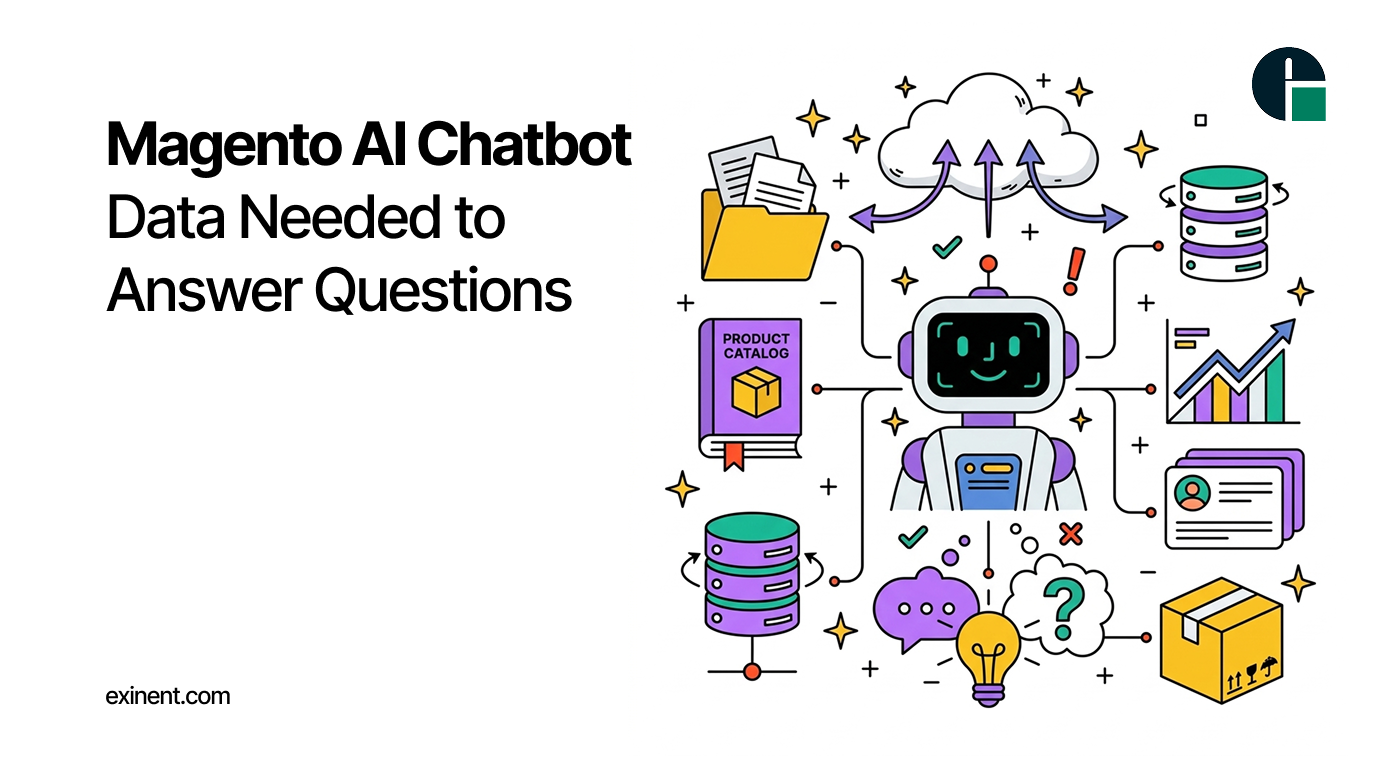
Modern Magento chatbot solutions can connect with product catalogs, inventory information, order systems, and customer data. This enables them to provide more context-aware assistance instead of simply displaying pre-written answers.
Magento AI Chatbot vs Traditional Customer Support
1. Response Speed
Speed is one of the biggest differences.
Traditional customer support depends on agent availability. Even efficient teams may have periods when customers need to wait for a response.
An AI chatbot can respond almost instantly to common questions. Customers can ask about products, shipping, returns, or orders and receive assistance without waiting for an agent.
For eCommerce businesses, faster responses can reduce friction during the buying journey and help customers make decisions more confidently.
2. Availability
Traditional support is generally limited by working hours and staffing levels. Businesses can provide 24/7 human support, but doing so can significantly increase operational costs.
An AI chatbot can operate continuously. It can assist shoppers during evenings, weekends, holidays, and high-traffic periods without requiring additional shifts.
This is particularly valuable for Magento stores serving customers across multiple time zones. AI chatbots can provide round-the-clock assistance while human agents focus on complex cases.
3. Scalability
Imagine your store receives 50 customer questions simultaneously during a major sale.
A human support team may struggle to respond to every customer immediately. Increasing staffing capacity can help, but it also increases costs.
AI chatbots can handle numerous routine conversations simultaneously. This makes them highly scalable for businesses experiencing traffic growth, seasonal demand, or promotional campaigns.
Instead of hiring more agents simply to answer repetitive questions, businesses can automate common interactions and allow their support teams to focus on higher-value tasks.
4. Personalization
Traditional support has an advantage when customers require nuanced, personal assistance. Human representatives can understand context, tone, and emotional cues in ways automation may not always replicate.
However, AI can deliver personalization at scale. A Magento-integrated chatbot can use relevant store data to recommend products, answer catalog questions, and guide shoppers based on their interactions.
For example, a shopper could ask, “I need a lightweight jacket for outdoor travel under $100.” An AI assistant can interpret the intent and suggest relevant products instead of requiring the customer to manually search through hundreds of listings.
5. Handling Complex Problems
This is where traditional customer support remains extremely valuable.
AI chatbots are excellent at repetitive and predictable requests, but complicated problems may require human judgment. Issues involving unusual refunds, payment disputes, account problems, complaints, or exceptional circumstances may be better handled by trained representatives.
A strong Magento support strategy therefore should not treat AI as a complete replacement for humans. Instead, the chatbot can act as the first line of support and transfer complex conversations to human agents when necessary.
6. Operating Costs
Traditional customer support requires salaries, training, scheduling, management, and infrastructure. As the number of customers grows, support costs can increase.
AI automation can reduce the workload associated with repetitive requests. It allows businesses to use human resources more efficiently by directing agents toward complex cases, sales opportunities, and customer relationships.
Industry guidance also highlights automation, faster responses, and 24/7 availability as key benefits of eCommerce AI chatbots.
Key Comparison at a Glance
| Factor | Magento AI Chatbot | Traditional Customer Support |
|---|---|---|
| Response time | Instant | Depends on agent availability |
| Availability | 24/7 | Usually business hours |
| Scalability | High | Requires additional staff |
| Repetitive queries | Excellent for automation | Time-consuming |
| Complex issues | Limited | Excellent |
| Personal empathy | Limited | Strong |
| Product recommendations | AI-driven | Agent-driven |
| Operating efficiency | High for routine tasks | Higher resource requirement |
| Human handoff | Can transfer to agents | Already human-led |
Why a Hybrid Approach Works Best
The real question should not be whether AI or humans are better. The better question is how both can work together.
A Magento AI chatbot can handle first-level support, including FAQs, product information, order tracking, shipping questions, and basic returns. When the conversation becomes complicated, it can route the customer to a human agent.
This creates a support model where automation handles volume while employees handle complexity.
Exinent’s Magento AI chatbot solutions, for example, are designed to provide automated support while supporting product recommendations, order-related assistance, personalization, and Magento integration.
How Magento Stores Can Get Started
Businesses considering AI customer support should begin with clearly defined use cases. Identify the questions your support team receives most frequently and determine which ones can safely be automated.
Next, connect the chatbot with accurate product, order, inventory, and policy information. Poor-quality data can result in poor answers, so maintaining reliable knowledge sources is essential.
Finally, establish a human handoff process. Customers should always have a clear path to human assistance when the chatbot cannot adequately resolve their issue.
Conclusion
Magento AI Chatbots and traditional customer support each have important strengths. AI excels at speed, availability, scalability, repetitive questions, and automated shopping assistance. Human agents remain essential for empathy, complex problems, exceptions, and high-value customer interactions.
For most growing Magento stores, the strongest strategy is not choosing one over the other. A hybrid model combines AI automation with human expertise to deliver faster, more scalable, and more responsive customer service.
By implementing the right Magento AI Chatbot solution, businesses can automate routine support, engage shoppers 24/7, and allow their customer service teams to concentrate on conversations where human expertise matters most.
FAQ’S :
What data does a Magento AI chatbot need to answer customer questions?
A Magento AI chatbot typically needs access to product information, categories, pricing, inventory, shipping details, return policies, FAQs, and customer support content. It may also use order and account data when personalized responses are required.
How does a Magento AI chatbot use product data to answer questions?
The chatbot uses product names, descriptions, specifications, attributes, prices, images, and availability to understand customer queries. For example, it can use product attributes to answer questions about size, color, material, compatibility, or features.
Does a Magento AI chatbot need inventory and stock data?
Yes. Real-time or regularly synchronized inventory data helps the chatbot provide accurate information about product availability. It can tell customers whether an item is in stock, out of stock, or available in a specific variant.
What customer data does a Magento AI chatbot need for personalized answers?
For personalized support, the chatbot may need information such as customer name, account details, order history, shipping status, and saved preferences. Access should be limited to the minimum data required and protected using appropriate security controls.
Can a Magento AI chatbot answer questions about orders and shipping?
Yes, when it is integrated with Magento order and shipping data. It can retrieve information such as order status, shipment tracking, estimated delivery, and available shipping methods after securely verifying the customer.
What Magento data is needed for returns, refunds, and cancellation questions?
The chatbot should have access to current return, refund, cancellation, warranty, and exchange policies. It may also need order information to determine whether a specific order meets the applicable eligibility requirements.
How often should Magento AI chatbot data be updated?
Dynamic information such as inventory, prices, promotions, and order status should be synchronized frequently or in real time. Static content such as FAQs and policies can usually be updated whenever the underlying information changes.
Is customer data safe with a Magento AI chatbot?
Customer data can be protected by applying access controls, encryption, authentication, data minimization, and secure API integrations. Businesses should also ensure the chatbot only accesses the data required for its specific functions.
What is the best way to prepare Magento data for an AI chatbot?
Start by organizing accurate product, inventory, order, shipping, policy, and FAQ data. Then connect the chatbot through secure APIs or approved integrations, define which data it can access, and regularly test responses for accuracy and privacy.